In my training sessions and coaching, I am repeatedly asked the following question: What constitutes good project management? My answer, derived from more than 25 years of project work in various roles and numerous discussions with seminar participants and colleagues, can be summed up in five letters.
If you like, you can add three more letters. That might not seem like much. But simple principles for solving problems don't necessarily mean that their implementation is easy. They serve as a guide for our thinking, but should by no means replace the need for critical thinking. So be careful, what comes next won't necessarily make things easier – but it will certainly be more insightful and interesting.
Let's talk about the letters. They are Z, W, X, M, V. Helpful additions are H, P, M. Feel free to add your own letters. Ultimately, everyone needs their own personal orientation in the project jungle.
The letter Z stands for the goal.
The question of the goal is a key question we should ask ourselves whenever something is important. And that's often the case in projects. The initial phase, the initiation and definition phase, focuses on the goal itself. Keeping these letters in mind is a good first step towards project success. Ideally, it should be described simply and concisely so that everyone affected by the project understands it. Ideally, this description should include the benefits and the most important fundamental parameters. Anyone who has seriously attempted this knows how challenging it is to formulate goals in this way.
The question of the goal helps us in many project phases, for example, with more general considerations: What is the goal of the individual project phases? What is the goal of resource planning? What goal am I pursuing as project manager?
However, one should also ask this question in more specific cases: What is the purpose of this meeting? What is the purpose of using this technology, method, etc.?
These qualities of a useful goal description lead us to the second letter that accompanies us on our way through the project jungle: the W.
The letter W stands for good questions
A good question is half the battle. Questions help us get to the bottom of situations, tasks, relationships—in short, everything. They are like binoculars, a microscope, an X-ray machine, or a Swiss Army knife—not just for the project manager, but for every project participant. Those who are skilled at asking questions have an advantage when searching for useful answers. This is not only because good questions are the prerequisite for good answers, but also because it's crucial not to overlook any essential questions.
A question left unasked often represents a risk recognized too late, a missed opportunity, an unclear requirement, or forgotten tasks. One of the most effective methods for working with questions is through checklists. To create a useful checklist for a project, a project phase, or a project aspect, work through all conceivable "W" questions (who, what, when, where, why, how).
Here are a few "W" questions that often come up in projects: What is the benefit? What needs to be done? Who will do it? Who is responsible? Who is affected? When should it be done? How should it be done? Where...? How often...? How long...? What alternatives are there?
Ask yourself questions that broaden your perspective: How would the customer, quality manager, etc., see this? What needs do the conflicting parties have?
Ask focused questions: What exactly happened in detail? Where and how did the error occur? Ask solution-oriented questions: What would be different if the problem were already solved? How do we know that the solution works? Which solution has (not) helped in similar situations?
As you can see, questions are indeed THE universal tool of professional project work. But please also ask yourself the following question: Have all the essential questions been asked? What is the point of delving deeper into these questions? When is it time to act instead of asking?
Because now the next 3 letters come into play: XMV.
XMV stands for xunder Menschensinn (common sense).
Admittedly, the term isn't spelled correctly. But this slight variation of the word "gesund" (healthy), which is certainly also due to my Bavarian roots, always gets a laugh in my seminars and therefore sticks in the mind. I establish the connection to the "W" (common sense), because an important question (perhaps even the most important one) is: What does my common sense tell me? Or, if you doubt it (which demonstrates great wisdom, maturity, and advanced self-reflection): "Can I rely on my common sense in this situation?" or "Is my common sense, i.e., my wealth of experience, sufficient?" followed by the question "Whose common sense should I use as a second opinion or resource?" Because, unfortunately, nature has neglected to build a project mode into our brains that ensures we can use our own common sense in all situations.
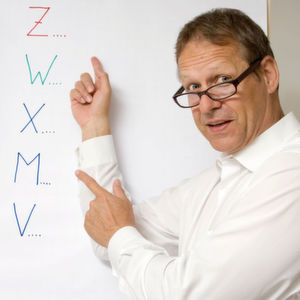
Z, W, X, M, V: Anyone who keeps these letters in mind,
is already well on its way to project success
(Image: foto art Elisabeth Wiesner)
If you enjoyed my little letter-project philosophy, you might also be interested in what the letters H, P, and M mean. Just send me an email with the subject line "Essence" to denkanstoss@microconsult.de. I will gladly send you further information and also look forward to your suggestions and comments.

 EN
EN  DE
DE