EN
EN  DE
DE Der Begriff Embedded Programming describes the development of software for embedded systems.
What are embedded systems?
Embedded systems are functional units that have their own computing kernel, which is "embedded" in the system.
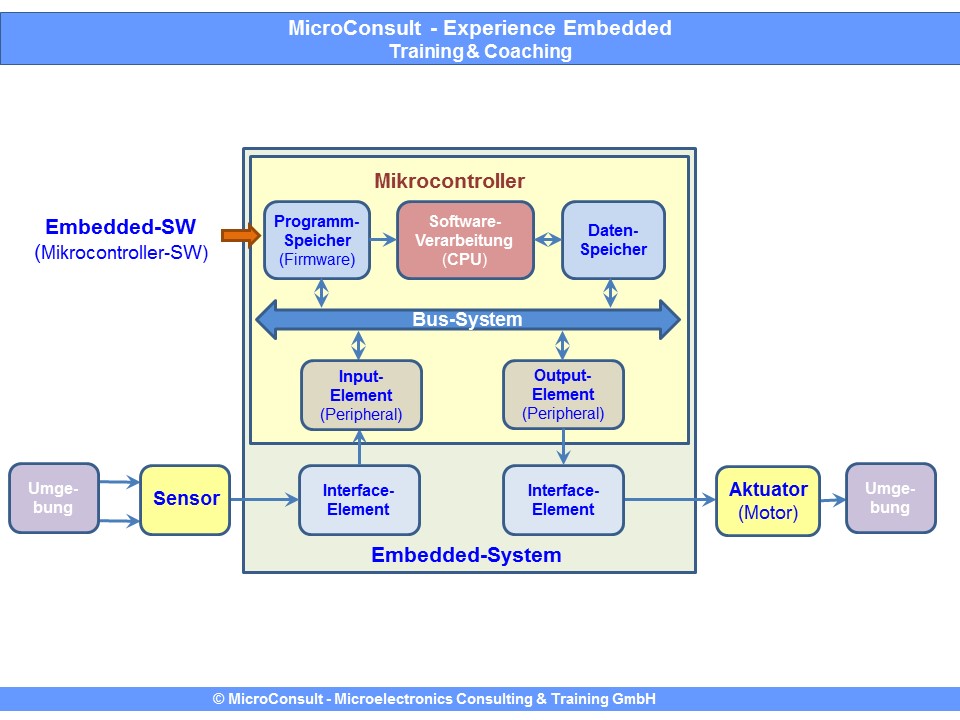
Image: Embedded system
Embedded systems contain inputs that can read control and communication information as well as sensor signals, and output this information, control and regulation signals, and communication information. The embedded software handles the processing of the input information and the control or generation of the output signals.
Difference between classical and embedded programming
What is the difference between traditional and embedded programming? Traditional programming uses languages such as ANSI C or C++. The generated software is then typically executed on a PC-based system. Here, a large amount of memory is available (many gigabytes of RAM and terabytes of hard drive storage, or several hundred gigabytes of SSD storage).
From the application's perspective, the program and data are executed in a shared main memory. Furthermore, PCs boast significant processing power in the form of very fast CPUs (single-core or multi-core) that handle software processing at clock speeds of several gigabytes. This allows for the efficient processing, execution, and processing of very large software packages.
However, embedded systems have limited memory capacity – typically less than 10 megabytes for program memory and less than 1 megabyte for data memory. Furthermore, program and data memory are separate.
Some microcontrollers (especially multicore microcontrollers) implement multiple core-local and global memories. Furthermore, embedded CPUs typically only achieve clock speeds of up to 200 MHz.
Advantages of embedded systems
The major advantage of embedded systems compared to PC-based systems lies in their real-time capability. This refers to the ability to precisely determine the delay or processing time of an embedded system. In other words, when an input signal (e.g., a switch signal) is detected, a maximum response time for generating a motor-off signal at an embedded system output can be precisely determined. Furthermore, the response time to a communication telegram, such as a telegram via USB, Ethernet, CAN, LIN, etc., can be determined. This ensures the determinism of the system; that is, under identical input conditions, the system always behaves the same way, and its behavior is predictable.
Embedded programming: Typical applications for embedded systems
- Automotive applications: Communication/control modules in the vehicle
- White goods: Control units for washing machines, dishwashers, and refrigerators
- Consumer electronics (brown goods): digital radios, televisions, set-top boxes
- Telecommunications devices: mobile phones, gateways (e.g. Fritz!Boxes)
- Industrial and medical technology, aerospace, military technology
These are very special embedded systems. Embedded PCs, which are used, for example, in machine controls. In this case, the embedded software is used with special embedded operating systems (e.g. Embedded Linux, Windows Embedded etc.) brought to an end.
Embedded programming – Embedded systems software
Software developed for embedded systems must include extensions to the ANSI C standard so that the hardware-centric approach, and therefore the performance (execution time), can be determined during programming. These ANSI C extensions include, in particular, type qualifiers for assigning a variable or program (function) to a specific memory area (so-called address space qualifiers). Depending on the address qualifier used, the compiler generates different sections that can be located in specific address spaces by the linker/locator. These type qualifiers (function qualifiers) also allow for the distinction between a normal function and an interrupt function. The embedded compiler then generates different operation code for function calls and returns using CALL and RET instructions.
Embedded software is also known as firmware (specialized device control software). Typically, the embedded software (embedded program code) is programmed in flash memory. The advantage of this type of memory is the ability to perform software updates (firmware updates).
Real-time applications
Embedded systems, which process embedded software, are an ideal platform for real-time applications. They combine the key success criteria for electrical controls with low power consumption and a small footprint at low cost. Numerous microcontroller architecture families with varying performance classes, different packages, and varying pin counts are available for this purpose.
The foundation for successful embedded programming is comprehensive knowledge – ranging from microcontroller architecture and requirements engineering to architectural design and embedded programming tools (compilers, linkers/locators, debugging and testing tools). Attending an embedded programming seminar provides the right access to all this necessary knowledge and skills.
MicroConsult supports you with training and coaching on all aspects of embedded programming, e.g. on the following topics:
Embedded C: Programming Methods and Tools for Embedded Applications (training)
Embedded C++: Object-Oriented Programming for Microcontrollers with C++/EC++ and UML (training)
Embedded C++ Advanced: Object-Oriented Programming for Microcontrollers with C++/EC++ (training)
Embedded Software Design and Patterns with C (training)
Software Architectures for Embedded Systems and Real-Time Systems
Requirements Engineering and Requirements Management for Embedded Systems
Embedded and real-time programming – all training courses
Embedded and real-time operating systems – all training
Coaching: Embedded and real-time programming
Embedded programming: Workshops
Furthermore, we offer individual workshops that highlight embedded software development - tailored to the specific needs of tasks, projects, teams, and roles.
Send us your questions, requests and requirements! Contact form