EN
EN  DE
DE Read on!
IoT – Internet of Things: Table of Contents
- Finding your way through the confusion of terms
- IoT: A breeding ground for new opportunities and risks
- Industry 4.0 is revolutionizing value creation.
- Infrastructures, products and services
- Security: Data theft in the cloud
- Manipulation of data (Big Data) could have devastating consequences.
- Digital Ecosystems
- The global language for networking
- Business models, value creation and competition
- Using the Internet of Things for business
- IoT expertise
- Flexibility is key.
- Learning by Doing
Preliminary remarks
If we had known what we were getting ourselves into by writing about the Internet of Things (IoT), we might have refrained from doing so. Like the internet itself, it's not only a bottomless pit, but it's also difficult to discern the edge of that pit. You get the feeling that you pick up on one topic and the whole world is connected to it: technology, society, the environment, politics… Globalization rears its ugly head.
In this trend guide, we have attempted to outline the dimensions of this topic and to define concretely what IoT essentially means for all those who develop software. From our perspective, this trend guide represents a balancing act that everyone who ventures into this field or simply stumbles into it faces. Ultimately, it boils down to one crucial question: How can I identify and implement concrete opportunities within the IoT universe?
What it's about
Internet of Things, Industry 4.0, Cyber-Physical Systems – buzzwords we encounter frequently these days, yet their meaning is rarely explained. And anyone trying to find out more quickly discovers that they need the vocabulary of a digital native to understand a text or follow a conversation. Is it all just hype, a bubble filled with hot air?
We think not. The terms describe less of a new technology and more of a trend whose content lies more in the future than in the past. In other words, little has happened yet, but much more is to be expected.
The Internet of Things (IoT) holds great promise. Numerous publications, lectures, and seminars discuss at length how we can benefit from these developments. Everything is supposed to become simpler, clearer, more transparent, more efficient, and above all, more convenient. We are in the midst of a development that has, and can continue to develop, evolutionary characteristics.
Finding your way through the confusion of terms
The underlying technological development required for the emergence of cyber-physical systems, Industry 4.0, and the Internet of Things (IoT) is a high-performance technical infrastructure based on affordable, high-bandwidth internet connections capable of addressing a large number of devices. This is complemented by technologies that provide computing power, data storage, sensors, and actuators in increasingly compact, energy-efficient, and cost-effective solutions. Combined with increasingly efficient energy storage systems, this constantly opens up new mobile application possibilities. IoT is consistently extending the principle of networked intelligent systems to ever-expanding fields of application.
The emergence of the Internet of Things in its various forms was only made possible by the switch from the IPv4 system to the hexadecimal IPv6 system for IP addresses. While IPv4 could generate around 4 billion unique addresses for network participants, IPv6 can generate around 340 sextillion; an unimaginably large number with 36 zeros. No one can currently estimate how long this number will suffice, but it will likely be quite some time.
Here is the number to look at: 340,000,000,000,000,000,000,000,000,000,000,000,000.
In the age of interconnected devices, every device—that is, every participant in a network—needs its own unique IP address for communication. Therefore, this step was both unavoidable and a kind of trigger signal for the emergence of the IoT. To illustrate the possibilities of IPv6, consider this: On every square millimeter of the entire Earth's surface (including all lakes and oceans), several thousand addresses could be accommodated, each unique and never repeated.
IoT: A breeding ground for new opportunities and risks
Literature and film repeatedly explore the unforeseeable consequences of technology that has become too intelligent and therefore too autonomous. While this may all be fiction, the consequences of such developments are, on the other hand, difficult or impossible to predict today.
Many technological success stories, and unfortunately also many disasters, are based on the evolutionary principle of emergent properties. This principle states that through the networking of units into a system, this system generates new properties and capabilities that did not previously exist and were perhaps even unforeseeable. This can lead to profound changes in the environmental conditions for everyone who interacts with this system directly or indirectly. It can transform products, industries, and economies. It affects the relationship between customers and suppliers, the availability of goods and services. It can have an impact on social systems and ecosystems—indeed, on almost everything.
This presents both opportunities and risks. Emergent properties of new systems can lead to profound changes and have a disruptive effect. Existing technologies, products, methods, and habits may then be relegated to irrelevance.
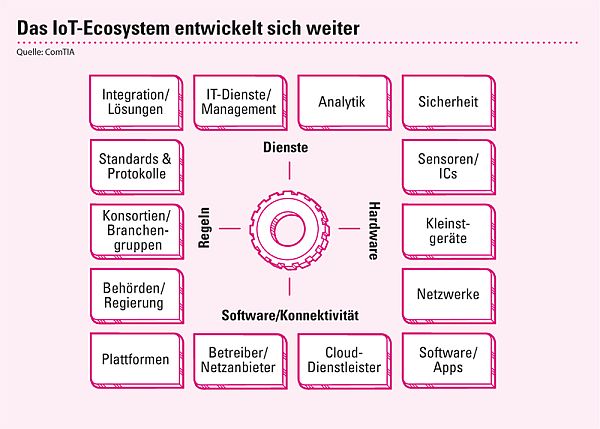
Image: The Internet of Things ecosystem
Complete Trend Guide „IoT – Internet of Things“ Download as PDF.
Training & coaching on the topic of system and hardware development
Training & coaching on the other topics in our portfolio can be found here.
Furthermore, there is the possibility to explore the topic area IoT – Internet of Things and Embedded Software Engineering also in tailor-made workshops to address. They are tailored to the specific needs of tasks, projects, teams, and roles. Get in touch with us! Contact form