EN
EN  DE
DE If you're looking for the perfect excuse for failed projects, you'll find it in the following sections. Whether it's miscalculations, overlooked errors, neglected testing, or sloppy documentation, it all stems from – and here comes a term you absolutely must remember – the "economics of thinking.".
Put simply, "economics of thought" means that we only think when it's worthwhile or when we have nothing better to do.
When is thinking worthwhile for our brains? I mean, really consciously thinking! It's only worthwhile when we find ourselves in a situation that's new to us or presents us with a choice. AND the thinking must, with a high degree of probability, lead to a useful result within a reasonable timeframe. Otherwise, it's either a waste of energy or a waste of time. Both are uneconomical.
Consider for a moment what the most important characteristic of a reaction is in life-threatening situations, such as a fall or a dangerous traffic situation. It is the very rapid retrieval of automated movement sequences. Since time, more than any other factor, determines life or death, our brain employs highly goal-oriented strategies to save time. And since thinking, as we all know, is a rather leisurely process, our brain prefers to conserve energy in this area.
- It tries to determine as quickly as possible whether further thought is worthwhile, i.e., whether the situation is unknown or requires a choice. To ensure this works, even though no two situations are exactly alike, our brain isn't overly meticulous when it comes to details. After all, it wouldn't make much sense if you only reacted to red cars that cut you off.
- It automates all frequently repeated processes, so that no conscious thought is required to initiate and execute them. Against this backdrop, the enormous importance of children's play or the intensive practice of important processes becomes clear.
- In critical situations, it ensures that thinking isn't even possible by simply suppressing rumination through hormonally controlled thought blocks. What good is it if your gravestone reads: "He thought things through and realized that it's better to survive thoughtlessly than to die pensively"?.
As a software developer, these strategies should sound familiar. To avoid reinventing the wheel every time, you use design patterns. For frequently recurring processes, you create functions or objects that you can use flexibly with the help of variables. When an important event occurs, you use an interrupt to halt anything that could delay the response.
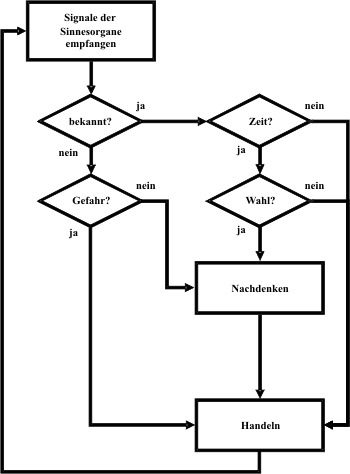
A software engineer would describe the process by which our brain decides whether it's worth thinking something down roughly as follows.
Besides saving time, our brains also like to conserve energy. For its comparatively small volume, which in my case (height: 1.90m, weight: a generous 90kg) is only about 1.5 times my body weight, it consumes approximately 201T of energy. Seen in this light, the saying "my head is smoking from thinking" is an exaggeration, but not entirely far-fetched. One might also get the idea that intense rumination can help one lose weight. This also works, especially if one focuses on their eating habits.
But all joking aside. Thinking is an incredibly complex process, accompanied by countless chemical reactions. The energy for this is generated in the cells from high-quality glucose and oxygen. Since humans didn't have supermarkets for many millennia, and obtaining high-quality food involved considerable effort and risk, it wasn't advisable to simply waste mental energy. While most software developers in Germany currently don't have a food procurement problem, our genes play it safe in this regard.
So far, so good. But where there is light, there is also shadow. Like almost everything, this has not just one, but several catches:
- The decision of whether reflection is worthwhile must necessarily be made before we can consciously think. At best, our mind can still pull the emergency brake if there's still time and stress hormones haven't already caused a mental block.
- Many automatic behaviors were established in childhood or heavily influenced by life situations that had little to do with complex project work. It's also possible that methods and processes have been perfected over years, only to lose their relevance due to new technologies and insights. The risk of resorting to unsuitable automatic behaviors is ever-present.
- Stress hormones don't care whether you're mountain climbing, driving a car, or programming. For millennia, evolution was unfamiliar with the concept of "complex technical projects," and for a long time, it played no role in our personal development either. Unfortunately, there's no sensory organ that tells the brain: "This is project stress, stay calm and think.".
A small experiment during an ADAC safety training course vividly illustrated these connections for me. The task was: Drive quickly towards an obstacle and swerve in the direction the ADAC safety instructor was NOT pointing with his arm. I tried it several times, but I couldn't manage the not-so-complex mental step of "I have to drive differently than he's pointing" in time. My consolation was that most of the others fared no better.
The economics of thought thus leads us to rely on automatic processes in complex projects, especially under time pressure, which may do us more harm than good. It is not sensible to try to circumvent these automatic processes, for example with psychotropic drugs or other substances, because firstly, we urgently need them in many other life situations, and secondly, the side effects of such doping are disproportionate to any benefit.
So, have we found the perfect scapegoat for failed projects: evolution?
No, I'm not letting you off the hook that easily! Since you're not stressed right now—otherwise you wouldn't be reading my article—you can do what evolution intended for situations where "important problem identified and time available": think consciously. I know it's tempting to avoid this by desperately searching for a new source of stress. For once, please refrain from doing that. So, what can you do to at least largely avoid these drawbacks? Once you've given it some thought, read what I've been thinking under "Reflections on Projects.".
Thoughts on projects
I knew it. They skipped ahead for economic reasons. I respect everyone I'm wronging right now. Back to the topic:
There are clearly several triggers that lead to economically driven thinking with uneconomical project outcomes: time pressure, unsuitable automated processes, and stress. What are the underlying causes of these triggers?
- Time pressure arises primarily from unrealistic project planning. A key reason for this lies in the economy of thought. Because our brains automatically try to simplify all perceptions as quickly as possible, we tend to underestimate complexity. This is particularly pronounced in software projects.
- Due to a lack of routine and binding rules, ineffective automatisms such as head-to-keyboard programming or "if it works, it fits" tests are used.
- The aforementioned causes inevitably lead to project stress, which in turn fosters automatic reactions that trigger panic-like behaviors such as hiding or aggression. Inappropriate automatic reactions and stress thus reinforce each other, creating a vicious cycle.
These causes practically point us straight to the solution. Since we can't change the fundamental way the brain works, we need to implement suitable automated processes in the project and ensure that time for reflection is available at critical points, thus avoiding unnecessary pressure. In short: it's about learning, practice, and project design.
Especially in software projects, the solution lies in resisting the temptation of haphazard implementation and rushed execution, and instead proceeding competently, strategically, and systematically from idea to solution. The success of a project is largely determined by the following initial conditions:
- A solid education with intensive practice lays the foundation for effective, automatic responses. Especially when previously proven but now outdated methods or processes are replaced by new ones, intensive practice is essential to avoid reverting to old thought patterns. The key here is: the hardest part of learning something new is unlearning the old.
- The clear structuring of the task and the timeline makes reflection worthwhile because meaningful results can be achieved within an acceptable timeframe. Good project management and workable processes create these conditions.
- Binding review steps at key points in the project ensure that deviations from the objectives provide the necessary impetus for worthwhile reflection.
The solutions are nothing new. But perhaps it is worthwhile to reconsider these solutions from the perspective of the "economics of thought".
I look forward to your suggestions below. denkanstoss@microconsult.de.
Further information
Training & coaching
MicroConsult Training & Coaching on project management
MicroConsult training and coaching - overview
Food for thought:
Column by Peter Siwon about the human side of project work
Peter Siwon: Systemic project management