EN
EN  DE
DE Don't worry, you don't necessarily need to see an endocrinologist if your software project is in crisis. However, it's certainly helpful to understand the connection between hormones and project work. In any case, this knowledge will definitely help you make a strong impression at the next project crisis meeting.
With a straight face, they simply utter the following portentous sentence: "Well, dear colleagues, our hormones have really gotten the better of us." To substantiate this claim and prevent your colleagues from mistakenly thinking it's a new software virus, it's worth studying the following lines.
In my last Food for thought In my book ("The Economics of Thinking"), which you should also read right away, I described how our brain is extremely driven to optimize our thinking according to economic principles. Whenever something is particularly urgent, it forgoes cumbersome thought and instead relies on automatic thought processes that save time.
Another reason to switch to automatic mode is when routine tasks need to be performed. In this case, using conscious thought would not only be a waste, but the cumbersome, slow rumination would actually be more of a hindrance than a help. So far, so good.
The catch is that the brain has to decide what's urgent and important before we—as users of conscious thought—can even consider it. Otherwise, the whole effort to save time and energy would be pointless. And that's precisely where this seemingly vicious cycle begins. If you think about it, you might act too late, and if you don't think about it, you risk doing something you might later regret. Whichever way you go about it, you're doing it wrong, yet somehow right.
This is a point that really warrants reflection. I can't find anything wrong with the system our brain uses here. Or do you have a better idea than the solution evolution has devised for you over three billion years – to do what you do best when every second counts?
Let's consider this using a familiar analogy. Who's to blame when a train goes the wrong way, the switch or the signalman? You probably recognized it immediately: the signalman. Now, who is the signalman in our brain? Who determines where the train of our thoughts goes—towards panic, sober thinking, enthusiasm, or indifference? According to current knowledge, the hypothalamus deserves the title of signalman. It's a tiny cluster of nerve cells, weighing only about 15 grams compared to the size of the brain (approximately 1.3 kg), but it packs a powerful punch.
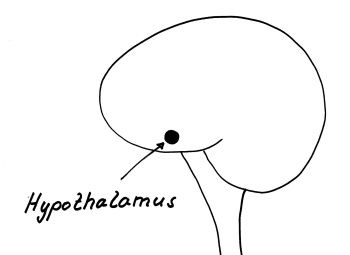
Location of the hypothalamus in the brain
The hypothalamus plays a crucial role in our emotional life, acting as the interface between thought and feeling. On the one hand, it influences the hormonal system, and on the other, it plays a vital role in the brain's motivational system. Whether we feel good or bad, or more specifically, hungry, thirsty, aggressive, excited, anxious, or tired, is largely determined by this small cluster of cells.
Even before our conscious mind becomes active, it assesses the overall situation and sets the body aroused via the hormonal system. And now the circle closes, because these biochemically triggered states of arousal represent the precursor to our subjective assessment of what is urgent and important. They are interpreted by significantly more complex areas of the brain, responsible for our psyche, as sensations such as fear or joy.
The outcome of this interpretation depends significantly on our previous experiences with this or similar situations. These experiences can vary greatly. Jumping into the water is pure pleasure for a good swimmer, but pure stress for a non-swimmer. The crucial factor is the extent to which our psyche perceives the situation as controllable or manageable.
Our psychological assessment sends a signal back to the hypothalamus via neural pathways, which then either further intensifies or reduces the level of arousal. The more uncontrollable the situation appears, the greater the increase in arousal. The greater the arousal, the more panicky and disorganized behavioral patterns emerge.
Similar effects occur when we experience states of arousal as very pleasant or even euphoric. This, too, tends to lead to unreflective behavior, as the ability to control a situation is misjudged in this case as well. A moderate state of arousal, which we perceive, for example, as anticipation, keen interest, curiosity, or even sadness, is best suited for tasks that require critical thinking.
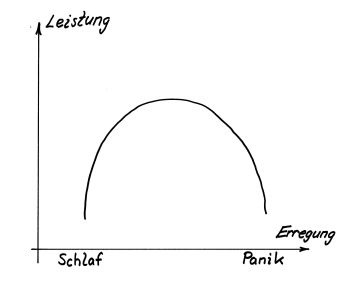
We achieve optimal performance in tasks that require critical thinking when we are in a medium state of arousal.
This clarifies when projects are at risk of spiraling out of control: under high stress, caused by a feeling of loss of control, or by excessive euphoria resulting from an overestimation of one's ability to control things. In other words, whenever hormonally induced cognitive difficulties hinder deliberate action. And all this because of a 15-gram cluster of cells, only the size of a 2-cent coin, called the hypothalamus, which has existed longer than humans have been able to think logically.
You can find out what can be done about hormonal emergencies in the section "Projects in the Hormonal Crisis: Prevention and First Aid".
Projects in the hormonal crisis: Prevention and first aid
Based on the relationships outlined in the section "Hormonal Emergencies in Projects," various approaches for prevention and first aid can be derived for projects. The aim is to avoid adverse states of arousal, such as high stress or excessive euphoria, or to reduce them to a level that is conducive to the work outcome.
In my opinion, the feeling of loss of control in projects has primarily the following causes:
- Important information is missing to assess the project.
- The guidelines contradict the experiences of those involved.
- The requirements cannot be met with the assigned powers.
- The requirements cannot be met with the available knowledge.
Excessive euphoria can be the result of various external factors:
- Important information is missing to assess the project.
- There is a lack of knowledge and experience for a realistic assessment of the project.
These causes can be addressed with the following organizational measures:
- Involving key stakeholders with experience and concerns in project planning
- Transparent project planning and tracking
- Open communication of problems and conflicts within the team
- Clear allocation of tasks and responsibilities
- Provision of available resources and means
- Sound education and training
- Playing through and practicing project situations
However, even if all organizational preventative measures are followed, the situations described will inevitably arise again and again; that's simply the nature of things. Therefore, additional measures that defuse highly stressful project situations are also advisable, as they benefit people's mental well-being and thus counteract stress-related agitation.
Strengthening team cohesion through measures that promote mutual trust or quickly resolve emerging conflicts.
For young teams or teams facing new challenges, the support of a project coach who compensates for the team's lack of experience is of great benefit.
- Avoidance of destructive coercive measures, such as threats or insults.
- Use of positive reinforcement, especially through recognition and respect
- A management team that supports the project team instead of stabbing them in the back.
- Consciously celebrate successes and just as consciously bury defeats
- Recovery phases after difficult project phases
I look forward to your suggestions and ideas regarding prevention and first aid.
Write to me denkanstoss@microconsult.de.
Further information
Training & coaching
MicroConsult Training & Coaching on project management
MicroConsult training and coaching - overview
Food for thought:
Column by Peter Siwon about the human side of project work
Peter Siwon: Systemic project management