EN
EN  DE
DE 
In many projects, there is a gap between bare-metal development and embedded Linux. Linux is powerful, but often too resource-intensive. Pure microcontroller implementations without an operating system, on the other hand, quickly become difficult to manage as complexity and maintenance requirements increase.
The Zephyr RTOS positions itself right in the middle of this tension.In our webinar "Why should I force Zephyr on my microcontroller?" (German) , Zephyr expert Andreas Klinger introduced the system and demonstrated why it is becoming increasingly important in modern embedded applications.
What sets Zephyr apart?
Zephyr is an open-source real-time operating system that enables deterministic behavior and was developed specifically for resource-constrained systems. It combines classic RTOS principles with a modern open-source architecture and remarkably flexible configurability.
Its key features include:
- deterministic real-time behavior
- high scalability – from very small microcontrollers to more powerful systems
- fine-grained configurability
- Apache 2.0 license without copyleft obligations
- compilation into a single executable
This last point, in particular, is relevant from an architectural standpoint: The operating system, drivers, hardware abstraction, and application are combined into a single image. This model reduces complexity and simplifies industrial product integration.
Licensing model – planning certainty for industrial products
Zephyr is licensed under the Apache 2.0 License. Unlike the GPL, this means
- no obligation to disclose proprietary application source code
- no copyleft requirements for product distribution
- only minimal documentation requirements
For many companies, this is a decisive factor when choosing an RTOS. The license allows for proprietary development without subsequent legal uncertainties.
Scalability below the Linux threshold
A key design principle of Zephyr is extreme adaptability. While embedded Linux typically requires several megabytes of RAM, Zephyr can run with just a few kilobytes.
This flexibility stems from its consistent configurability. Optional features include, among others,
- various scheduling models
- logging subsystems
- shell functionality
- heap management (can be managed separately in kernel and user space)
- memory protection mechanisms
- individual driver subsystems
A particularly practical aspect: Memory requirements are calculated precisely during the build process. If the available RAM is exceeded, the build aborts. Resource issues are thus identified early on and not only after deployment.
Device tree - a familiar concept, efficiently implemented
Like Linux, Zephyr uses the device tree concept to describe hardware. The difference, however, lies in the timing of processing. While Linux interprets the device tree at runtime, in Zephyr it is fully resolved at compile time. C preprocessor mechanisms transform hardware definitions directly into executable code.
Consequences:
- no runtime overhead
- complete elimination of unused hardware components
- minimal footprint
Linux DTS files cannot be used directly because the driver model is different. However, structural orientation remains feasible.
Development environment – modern and familiar
For developers with a background in embedded Linux, Zephyr feels familiar right away. The toolchain is based on established components:
- C
- CMake
- Kconfig
- Git
- GDB / OpenOCD
- VS Code Integration
The central management tool is the meta-tool west, which bundles build processes, board management, debugging, and repository synchronization.
The entry barrier has been deliberately kept low: a simple main.c, a project configuration, and a CMake file are all that’s needed to create a first working system. The operating system is integrated via the build mechanism.
Scheduling – powerful yet customizable
Zephyr offers a sophisticated scheduling model with
- hardware interrupts
- high-priority meta IRQ threads
- cooperative threads
- preemptive threads
- idle thread
Importantly, this model is configurable. Developers can greatly simplify the system or design it to be more complex - depending on the use case. Zephyr does not force developers to use the maximum functionality.
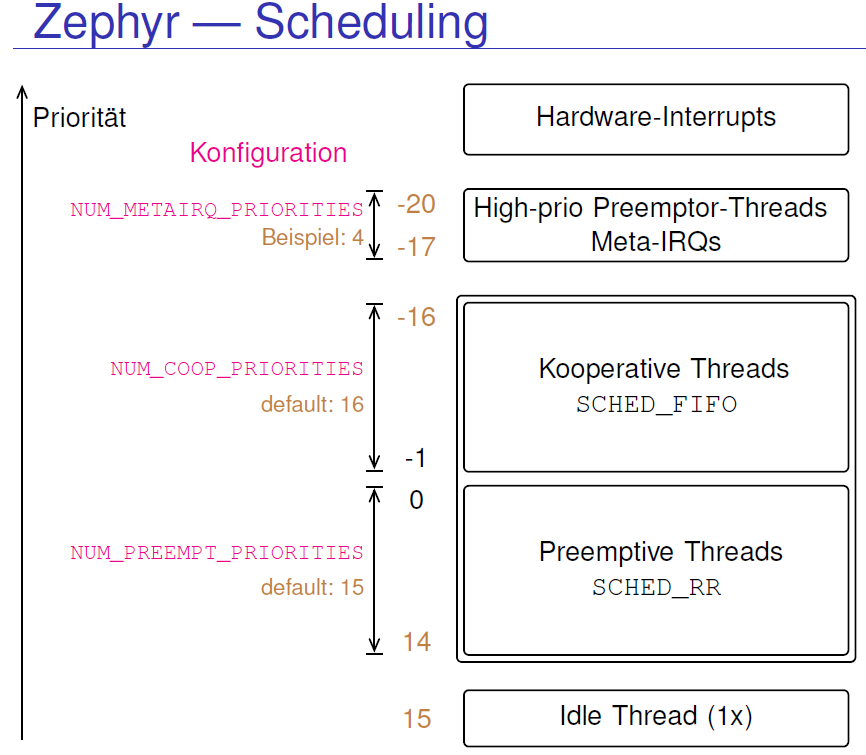
Figure 1: Zephyr scheduling
Typical applications
Zephyr is particularly well-suited for applications where Linux would be too large or structurally over-engineered. These include, for example:
- battery-powered sensors
- IoT devices
- wearables
- industrial controllers
- low-power systems
Low-power modes of microcontrollers are explicitly supported.
Zephyr is currently less suitable for complex multimedia or video applications with high data throughput; in these cases, embedded Linux is usually the better choice.
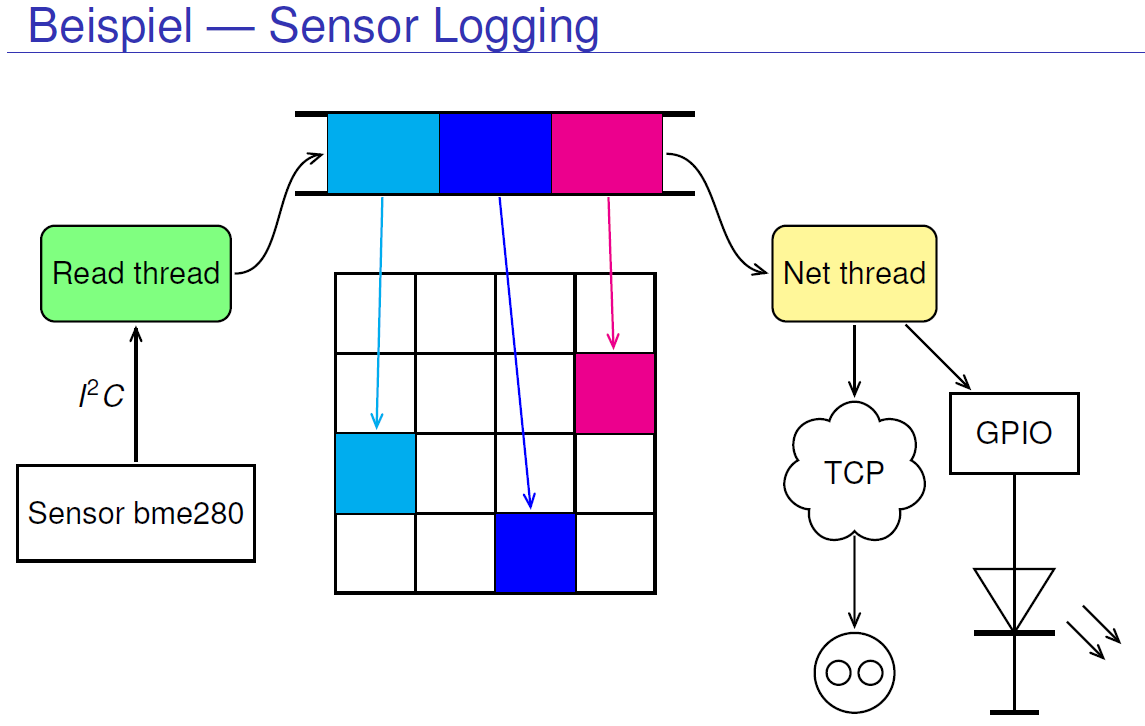
Figure 2: Exemplary Zephyr project
Conclusion: Bridging the gap between bare metal and Linux
Zephyr bridges a critical gap in the embedded ecosystem. It offers deterministic real-time behavior, a modern open-source architecture, and exceptional scalability - without the structural complexity of a Linux system.
For those working below the Linux threshold but still wanting to benefit from a clear system architecture, a modular driver structure, and professional tooling, Zephyr offers a powerful alternative.
MicroConsult supports companies in this process, from architecture consulting and project-based coaching to hands-on seminars where developers systematically learn Zephyr and apply it directly.
The MicroConsult Zephyr Training (German) teaches you how to set up a Zephyr target. The focus is on the set-up and operation of a Zephyr system with hard real-time properties. The Zephyr training uses freely available open-source software only.
Register now! The next date is from 14 to 17 December 2026.
Further information
MicroConsult Training: Open-Source-RTOS Zephyr – der kleine Bruder vom Tux
MicroConsult Training & Coaching: Embedded and real-time operating systems
MicroConsult Expertise: Embedded and real-time software engineering