EN
EN  DE
DE How power struggles kill projects
Scene 1: "That's it, end of story, that's how it's done!" The go-getter doesn't beat around the bush, but gets people moving and makes sure things "get done." Really?
Scene 2: The project manager and the expert from the project team are hopelessly stuck in a "technical" discussion, and the tone is becoming increasingly aggressive.
You're probably familiar with scenes like this. Is this kind of approach conducive to project success? No! Are there better alternatives? Yes! If you want to know more, which I sincerely hope you do, then please read on.
I'm glad you're taking the time to read my arguments. You've already taken an important step towards alternative behaviors: you're willing to listen to or read about the arguments.
Let's take a closer look at the scenes. What could be the backstory of Scene 1? The following is conceivable: The boss and driving force, let's call him Ludwig (his favorite saying: "Le projet c'est moi!"), 44 years old, has called a meeting. Ostensibly, he wants to discuss the approach with his team, adjust it if necessary, and decide on it. In reality, he already knows exactly how it should go. He simply wants those present to reverently acknowledge his brilliance and obediently nod their approval of his opus. But then, a clever clogs actually dares to openly criticize, raise objections, and—Ludwig can hardly believe it—even pull a counter-proposal out of his hat. The troublemaker is a self-assured 29-year-old developer, let's call him David (his favorite saying: "When I'm in the lab, I do what I want anyway!"). David's opening line, "That won't do!", sends Ludwig's adrenaline levels soaring.
At this point, scene 1 could transition into scene 2: Both Ludwig and David dig verbal trenches, mine the terrain with petty barbs, and rally their allies. From these battle positions, the "arguments" are then fired off with abandon. From minor skirmishes ("In my over 20 years of experience" versus "New technologies require new methods") to full-blown battles ("You're wasting valuable time with your stubbornness!" versus "Why did you hire me as a software architect if you know everything better?"), everything is on offer. Ludwig fears for his authority because he senses he can't keep up on a technical level. He therefore prepares for the decisive blow: "I bear the overall responsibility here, so it will be done the way I want it done. Anyone who doesn't like it can leave. End of story!".
Certainly, things don't always go this drastically, but it's not uncommon for the more powerful position to prevail over reason. However, in most cases, this is a Pyrrhic victory, because the defeated party then goes underground and pursues their convictions ("This can't go on!") with subtle guerrilla tactics. These don't have to be conscious acts of sabotage. Our psyche has many unconscious strategies to retaliate for attacks on our ego: focusing on failure, demotivation, quiet quitting, working to rule, illness, and so on. Or David throws in the towel and quits. The go-getter loses precisely the person he actually needs most for the project's success. I think this example shows that it's worthwhile to consider alternative behavioral patterns on both sides.
Positions and motives
The core of the problem very often lies in two behaviors: 1. the urge to impose one's own position, and 2. the unwillingness to understand and respect the motives of others. In our example, Ludwig acts from the position of "I'm the boss, so I must know better," and David from the position of "I'm the expert, so I must know better." I believe it's understandable that no agreement can be reached from these positions when there are differing opinions on how to proceed. As long as both sides defend their positions, there is only one solution: the higher-up prevails. The more powerful one wins.
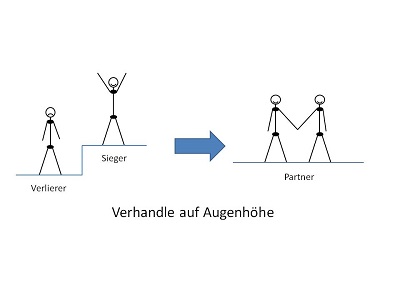
But the true power dynamics in high-tech companies are not as simply distributed as in dusty feudal systems, where the educated leadership elite at the top bought everything and the ignorant rank and file toiled at the bottom. In modern companies, managers would do well to understand that there is a power of experts, without whom they themselves are ultimately powerless.
The solution lies in respecting the other person's position and needs and seeking agreement under the umbrella of a shared interest. Those who meet on equal footing have a better chance of success.
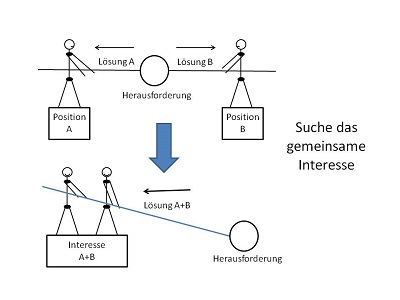
How might the scenes have unfolded if Ludwig and David had focused their discussion on their shared interest—the project's success—while simultaneously respecting their respective positions and needs? David would have phrased his suggestions as comments or additions, without claiming to offer the better solution, so as not to offend his boss. This would have addressed Ludwig's need for recognition of his authority. Ludwig would have listened attentively to David, thanked him for the suggestion, and thus acknowledged David's position as an expert. The team would then have discussed the pros and cons of the proposed solutions together and combined the ideas. The result, regardless of which approach it most closely resembled, would then be a... common Solution. Ludwig will finally announce: "Okay folks, that's how we'll do it. Thanks for the productive discussion." He remains the decision-maker and the doer.
The appeal of this alternative scenario is obvious. No one loses face, and there's a very high probability that not only will a better solution be found, but also that everyone will actively support the consensus reached. A happy ending instead of a warlike, apocalyptic scenario – if that isn't an alternative!
Tips for happy endings in solution negotiations: Request them now!
I look forward to your suggestions below. denkanstoss@microconsult.de .
Peter Siwon
List of sources:
Fisher, R./ Ury, W./ Patton, B.: The Harvard Concept, Campus Verlag Frankfurt, 2006
Schranner, Matthias: Negotiating in border areas, Econ Verlag, 2010
Siwon, Peter: The Human Side of Project Success, dpunkt.verlag, 2010
Prior, Manfred: MinMax Interventions, Carl-Auer Verlag Heidelberg, 2009
Birkenbihl, Vera F.: Negotiating correctly from a psychological and logical perspective, mvgverlag, 2011
Further information
Training & coaching
MicroConsult Training & Coaching on project management
MicroConsult training and coaching - overview
Food for thought:
Column by Peter Siwon about the human side of project work
Peter Siwon: Systemic project management