EN
EN  DE
DE How often are you interrupted at work each hour? It can be incredibly frustrating, especially when you're working on a tough problem that demands your full attention. Often, the victims of these communication attacks are themselves the perpetrators. This is a good reason to take a closer look at the topic of communication culture.
What's happening in many companies is a form of communication barbarity. It often comes at the expense of software developers who need to work with focus to achieve a usable result.
You're all familiar with the problems of task switching in software. Every switch from one task to another is resource-intensive. It's a similar situation when our thinking is interrupted. In the brain, every interruption also erases information from our working memory to make room for processing the new task. Working memory is to our brain what RAM is to our PC. After the interruption, a lot of information has to be painstakingly retrieved from memory. At best, we find these thoughts again by repeating previously considered ideas; at worst, they're gone. The result: wasted time, errors, frustration, and stress. This means that every unnecessary interruption is an attack on effectiveness, quality, our nerves, and ultimately, our health.
Against this backdrop, the blessings of our modern communication society have become a curse. Now, all avenues of communication are open: mail, email, text message, landline, mobile phone, and face-to-face contact. A nice side effect in open-plan offices: everyone benefits from the pinging, ringing, or jovial chatter across multiple desks. Thanks to MP3, we also enjoy a wide array of background noise. This is communication barbarism.
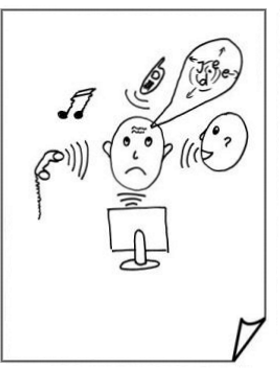
Communication barbarity can derail many a good idea.
These electronic leashes, the mobile phones, stop at nothing. You've probably witnessed, with amusement, someone in a trade fair restroom answering a business call in a hushed tone. The term "business" here isn't without a certain comedic element. The person on the other end can only hope that no one in the next stall flushes the toilet. It's bordering on perversion.
There is only one way to escape this madness: a culture of communication. The path to a culture of communication leads through simple considerations about the meaning and purpose of communication tools. The benefit of a mobile phone lies in the fact that you can decide whether you are reachable, regardless of location or time – not in being reachable anytime, anywhere. Is it acceptable to interrupt a face-to-face conversation for the sake of a phone call? Is it sensible to put yourself in danger just because the phone rings while you're battling through city traffic? Do you want to disturb other people during lunch or in the restroom? If you believe you are so important that you must be reachable at all times and in all places, then you are probably doing something wrong or overestimating yourself. What are answering machines and call forwarding for?
Emails are an asynchronous communication medium! Their advantage lies precisely in the fact that the recipient can respond when it fits into their workflow. For example, a rule could be that emails are answered with a maximum delay of one day. You can then safely disable pings, ringtones, or other "hello, this is an email" gimmicks.
Regarding interruptions from colleagues at work, I recommend an open discussion about disruptive communication habits. You'll discover that most people neither want to interrupt nor be interrupted. Continuously examine your communication practices. In hardly any other area of working life are so many mistakes made. At the same time, simple and highly beneficial solutions are readily available.
High-quality work results are also, not least, an expression of a highly developed communication culture.
Tips for promoting communication culture: Request them now!
I look forward to your suggestions below. denkanstoss@microconsult.de.
Peter Siwon
Experiment: Create a victim and perpetrator statistic
Most people are unaware of how often they are disturbed or how often they disturb others at work. Therefore, the following short survey is helpful. Make a tally of the following incidents:
Victimhood issues:
- How often are you interrupted at work during a day by phone, email, or personal contact?
- How many of these interruptions were inappropriate because an immediate response was not required or the interrupted activity had a higher priority?
- What could the troublemaker have easily done himself? That's a tricky question. But we all know it's a valid one.
Questions for the perpetrator (try to be as honest as possible):
- How often have you interrupted someone else's work, or how often would you have interrupted it, if you hadn't read this thought-provoking article beforehand?
- How often could you have chosen a more convenient time, such as a team meeting, or a different form of communication (e.g., an email or a note)?
- How often could you have avoided the disruption with a little thought or initiative? That's a tricky question, but we all know it's a valid one.
Further information
Training & coaching
MicroConsult Training & Coaching on project management
MicroConsult training and coaching - overview
Food for thought:
Column by Peter Siwon about the human side of project work
Peter Siwon: Systemic project management