EN
EN  DE
DE Project work, in particular, constantly presents us with difficult decisions, often requiring quick action. Those who make decisions assume responsibility and therefore also bear the risk of making the wrong choice. This makes them easy targets for scapegoating. Is it any wonder, then, that decisions aren't made but rather dropped like hot potatoes? It's a fascinating topic, perhaps too serious for a column. Regardless, I take full responsibility for my decision to write about decisions.
What characteristics define a decision? When are decisions even necessary? Let's consider these questions using a simple fork in the road in the woods, which also serves as a good metaphor for all kinds of decision-making situations, including in projects. The path splits, for example, in three directions: left, right, or center. If we know where we want to go and there's a signpost, then we don't need to decide, provided we can read. The signpost has kindly made the decision for us. If there's no signpost, then we make plausible assumptions, for example, about the direction in which our destination lies. Then we choose the path that points in that direction.
But experienced forest walkers among us know that this plausible assumption offers no guarantee of success. Many of these "this way" fantasies lead to unintended and surprisingly intensive explorations of the terrain. I don't deny that we make new and interesting discoveries along the way, which mask the flaw of the initial miscalculation.
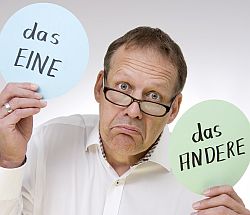
Decisions transform uncertainty and stagnation
in risk and ability to act
(Image: foto art Elisabeth Wiesner)
Decisions replace uncertainty with risk
The crucial difference between making a decision and following a signpost lies in the degree of uncertainty. With a signpost, it's practically zero, unless some prankster has tampered with it. With a decision, the uncertainty can be very high. You see, uncertainty is a necessary condition for making a decision. The risk of making the wrong decision is almost automatically built into every decision. We cannot make a decision without taking a risk, because if there were no risk, no decision would be necessary.
This connection, logical as it is, is often overlooked. The great advantage of making a decision, despite the associated risk, is that action can finally be taken. For example, we decide to turn right instead of starving helplessly at the fork in the road (okay, I admit I'm exaggerating a bit here). If we eventually realize that the path leads nowhere, we turn back and make a new decision based on the new experience. Anyone who goes right again is obviously extremely foolish, but the dumbest option of all would be to avoid making a decision altogether for fear of making a mistake and ultimately starve to death right there. We still have at least three options that represent a sensible alternative to starving to death: middle, left, or turning back.
In short: Without decisions there is no action; without action there are no new insights; without new insights there are no new basis for decision-making. The price for this benefit of making a decision is the risk of making the wrong one.
People who can bring about a decision are therefore something like masters of disguise. They transform uncertainty into the ability to act, because the decision clarifies what needs to be done. At the same time, uncertainty becomes a risk, because the decision and the resulting actions can later be interpreted as mistakes.
I deliberately use the word "interpreted" here because the accusation of a wrong decision was constructed retrospectively based on information that was unknown to both the decision-maker and the accuser at the time of the decision. Afterwards, many (especially those who like to avoid making decisions) believe they would have been wiser in the decision-making situation. Postscript: But they can't prove it! Second postscript: Why didn't they do everything possible to prevent a wrong decision?
Everyone bears responsibility in their own way.
Who bears the responsibility for deciding which path to take? If there's a "leader" who authoritatively dictates the direction, the responsibility for decisions is clear. He pays for his decision-making power with absolute responsibility for the group's fate. However, the group also bears the responsibility of following this leader like a flock of lambs. That, too, is a decision.
The other option is for one person to consult with the group before making the decision. In this case, the responsibility for the decision lies with that person, while the responsibility for the basis of the decision lies with the entire group. If one person moderates the decision-making process until a consensus is reached within the group, they assume responsibility for the process. In this case, the responsibility for the outcome lies with the entire group.
However things may unfold, the responsibility for whether and how decisions are made always lies with the entire group, as long as there is a realistic freedom of choice regarding membership in that group. Some bear the responsibility for their decisions, others the responsibility for not having to decide, not wanting to decide, or not being able to decide. Therefore, upon closer examination, getting rid of all responsibility is very difficult in practice.
Power is the ability to create security or insecurity.
What does power mean in this context? A person's power over others grows to the extent that they can transform insecurity into security for those people. Unfortunately, the reverse is also true. Your company has the power to improve your financial security, but also the power to take that security away from you again under certain conditions.
Applied to our hikers, this means that the person with the best local knowledge wields considerable power. They can increase the certainty of decisions or create significant uncertainty by threatening to abandon the group.
Power is often too closely associated with hierarchy. However, disciplinary power in companies is just one of many. If we see power as the potential to transform uncertainty into security, many possibilities for constructive power or influence open up: creating transparency, clarity, and understanding; making decisions; resolving conflicts; etc. Unfortunately, the destructive variant of transforming security into insecurity also comes into play: lack of transparency, obstruction, and intrigue. With whom would you like to go hiking? To whom would you place your trust and your full commitment?
I hope my thoughts haven't put you off hiking. My advice: Take your own map and compass with you. That way, you can decide for yourself how much control you want to give others over your destiny.
I now leave it to your decision and responsibility to apply these connections to projects, work teams, and companies. Of course, you bear the full risk. After all, I'm just a simple columnist.
If you are interested in the topic of decision-making and other interesting connections in projects, please send me an email with the subject line "Motivation" to denkanstoss@microconsult.de.
Further information
Training & coaching
MicroConsult Training & Coaching on project management
MicroConsult training and coaching - overview
Food for thought:
Column by Peter Siwon about the human side of project work
Peter Siwon: Systemic project management