EN
EN  DE
DE 
With the real-time operating system (RTOS) Zephyr, developers have a versatile open-source alternative at their disposal, optimized for small systems. Unlike Linux, which is designed for high-performance systems, Zephyr is particularly well-suited for microcontroller-based applications where memory and processing power are limited. What exactly makes Zephyr so compelling?
Linux reaches its limits when used on small microcontrollers with limited RAM and flash memory. Even the simplest Linux implementations require at least 4 MB of RAM, which is often unavailable on typical microcontrollers. This is precisely where Zephyr excels: With a minimalist and adaptable architecture, it is optimized for resource-constrained systems and offers the essential functionality of an RTOS – without the large memory footprint of Linux.
An operating system consisting of only a single executable module
Zephyr can run on a wide range of hardware, from small microcontrollers to complex systems. Drivers, libraries, and user applications can be customized via a configurable menu. The entire operating system consists of a single executable module, allowing for particularly efficient use of system resources.
A key advantage of the architecture is its flexible scheduling: Zephyr offers "Priority-Based Preemptive Scheduling" where tasks with higher priorities interrupt those with lower priorities. Additionally, developers can access different priority ranges, which can be further customized through additional fine-tuning, such as cooperative threads and preemptive priority classes.
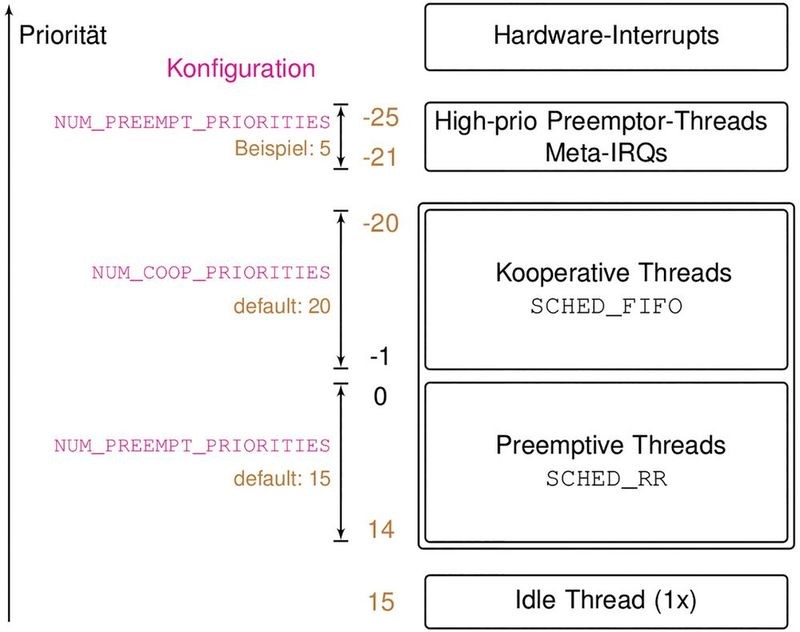
Figure 1: The priority band supported by the scheduler contains configurable areas for different thread types.
Efficient memory management prevents cross-thread conflicts.
In a system that processes multiple threads simultaneously, reliable memory management is essential. Zephyr uses a Memory Protection Unit (MPU) that allocates only the necessary memory space to each thread, thus preventing cross-threading. This architecture offers developers both flexibility and security.
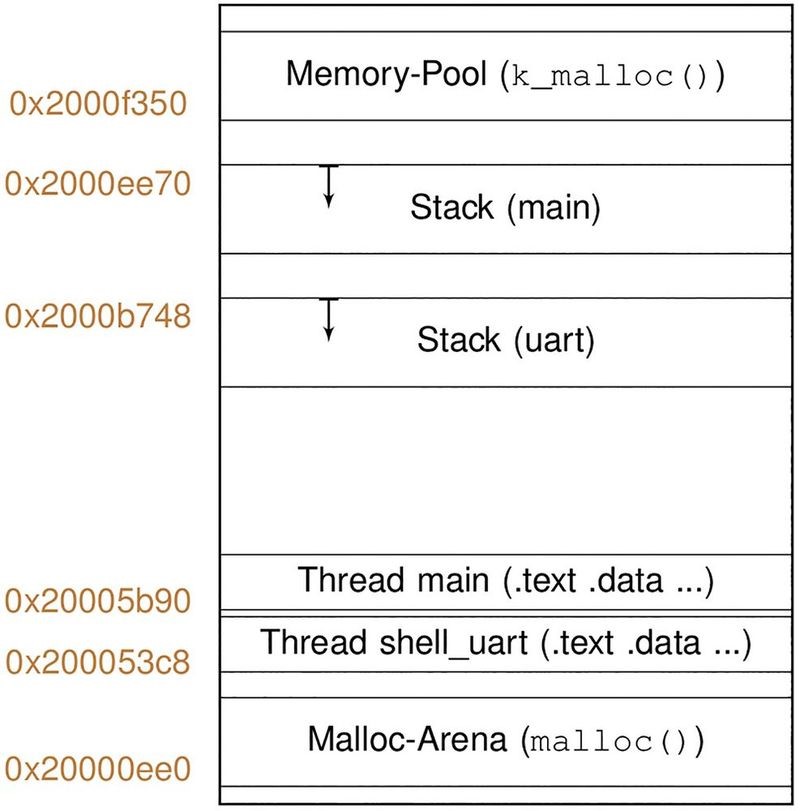
Figure 2: Example of a memory layout with two threads, kernel heap, and userspace heap. Compared to the screen output (Figure 3), the remaining threads have been omitted for clarity.
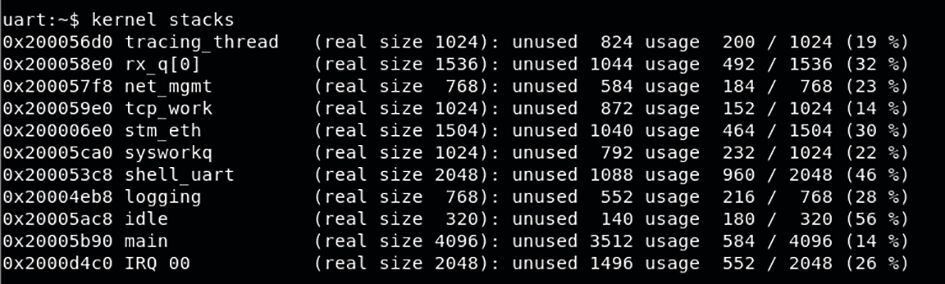
Figure 3: Overview of the available threads and their maximum stack usage to date
Zephyr is ideal for low-energy, long-running applications.
Zephyr supports both periodic timer events and a tickless architecture, allowing for even finer control of timing resolution. A system with the tickless kernel enabled generates events on an event-driven basis, minimizing the overhead of periodic ticks and increasing energy efficiency. This allows developers to adapt Zephyr for systems with extremely low clock frequencies – ideal for low-power, long-running applications.
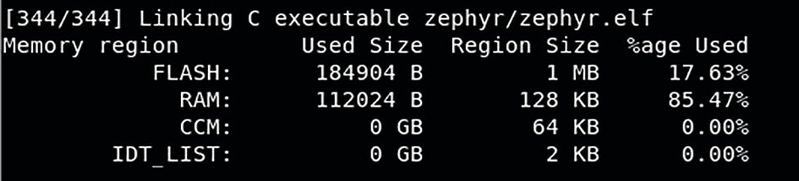
Image 4: Example from a build process
"West" simplifies configuration and debugging
The meta-tool "West" simplifies the entire process of configuration, development, and debugging in Zephyr for developers. The tool not only enables source code management but also assists in creating complex system configurations and debugging.
Device support and reusability through device trees
Zephyr relies on a well-designed device tree system that enables high reusability of hardware descriptions. This allows developers to adapt their system to different microcontrollers and boards without having to write a new configuration each time.
Conclusion: Reliable and scalable for many embedded projects
Zephyr is more than just a stripped-down Linux distribution: it's a modern, standalone real-time operating system designed for small embedded systems, offering developers flexibility, efficiency, and adaptability. This makes the RTOS an attractive choice for developers seeking a reliable and scalable open-source solution for numerous embedded projects.
Secure your place now in the Zephyr Training (German) from MicroConsult!
Further information
MicroConsult Training: Open-Source-RTOS Zephyr – der kleine Bruder vom Tux
MicroConsult Trainings: Embedded and Real-Time Operating Systems