EN
EN  DE
DE 
Whatever we do in a project, it almost always involves communication. The famous saying "One cannot not communicate" by the renowned communication scientist Paul Watzlawick certainly applies to projects as well. Even with our best efforts, misunderstandings are our constant companions.
Furthermore, systems theorists have discovered that organizations can only exist as long as communication continues within them. Error-prone yet unavoidable and necessary – this could get interesting!
Do you want to improve your communication and avoid misunderstandings? Then it's worth understanding what goes on in our minds.

A conscious look at the inner world brings interesting insights.
(Photo: foto art Elisabeth Wiesner)
Mastering a language and understanding its meaning are two different things.
We shouldn't be too pessimistic, because after all, many projects are working quite well. And in most cases, we get along quite well with our fellow human beings, even though not everything is clear.
Let's take a look behind the scenes of communication. For it to be possible, we need a medium for transmission. In our technologically advanced world, besides face-to-face conversation, there are many options: emails, videos, WhatsApp, social media, and so on. They all have one thing in common: they convey signals, not meaning. How so?
The proof is quite simple: If I receive a message in Chinese or Arabic that seems perfectly logical from the sender's perspective, it's completely useless to me. I'm receiving signals, but since I don't understand the language or script, I don't understand a thing.
To make sense of it, I need to have learned to interpret these signals. Sender and receiver need sufficient shared communication experience for communication to work. Then they believe they can understand each other. I'm deliberately phrasing this so vaguely because mastering the language and understanding the meaning are two very different things.
The meaning has many fathers and mothers
It makes a difference whether the same request comes from a colleague, the project manager, the client, or a powerful superior. Depending on the relationship, prior experiences, and expectations, the request can be interpreted as a favor, an obligation, or an order. It might also be a joke, or someone might feel addressed even though they weren't the intended recipient.
The meaning we ascribe to transmitted signals depends not only on our language skills but also on the circumstances under which we receive them—when, where, etc. Meaning has many origins: the relationship between sender and receiver, the relationships of sender and receiver to other people, past experiences, expectations for the future, the current situation, and so on.
All of this influences the interpretation of signals. One and the same sequence of signals can trigger very different interpretations, depending on these factors. A lot can happen in people's minds when they communicate. I emphasize: in their minds! The entire process of making sense takes place in our minds, or more precisely, in our entire bodies.
We create our own reality
For the sake of simplicity, I distinguish three stages of signal processing. These processing stages transform (external) reality into our own internal reality. We often mistakenly consider this internal reality to be THE reality. This explanation represents only a very simplified mental model that satisfies my compulsive search for meaning. It makes the complex reality, which I cannot understand in detail, plausible and practically usable for my relatively primitive conscious thought processes. Perhaps it will be useful for you as well. Please do not confuse the model with reality. It would be like eating the menu instead of the meal, or wandering around on a map instead of exploring the landscape.
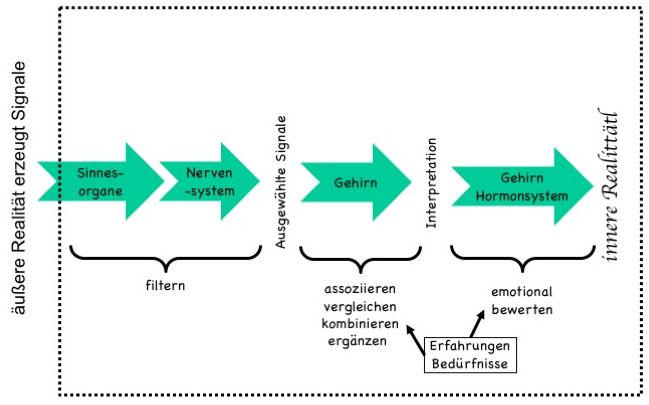
The transformation of reality into our inner reality can be simplified into three stages.
(Source: Peter Siwon, Seminar Systemic Project Management)
Signals that evoke an emotional response are important.
Stage 1, Filter:
People who are hungry or thirsty pay little attention to signals that don't satisfy these needs. Signals from supermarkets, restaurants, beer gardens, and snack bars, on the other hand, easily pass through this filter. Project teams seeking quick success tend to overlook details that hinder this goal. Stakeholders who are skeptical of the project primarily focus on problems and miss what's going well. This effect is also known as a self-fulfilling prophecy.
We see, hear, touch, smell, and taste. Through our sensory organs and the surface of our bodies, we gather physical and chemical signals from our environment. But even at this stage, a large part of external reality remains hidden from us, as the selection of signals we receive is limited by the properties of our bodies. Signals that have proven to be of little relevance to us humans in the course of evolution are not recognized. The nervous system then processes the remaining signals. The first question it asks itself is: Which signals are currently important? Crucial to the answer are the needs that are currently of particular importance. Needs are very effective signal filters.
Stage 2, Interpretation:
Now our brain tries to understand the meaning that might have been conveyed by the signals. We see smoke rising in the distance. At first, we take it for a fire. Shortly afterward, a loud bang. Now we combine the signals of smoke and bang and conclude that it could be an explosion.
In the project meeting, we combine spoken sentences, the facial expressions and gestures shown, as well as experiences with people and similar situations, to determine how seriously the statement "There's a problem with..." is meant. Is it a joke, an exaggeration, an understatement, a concern, or is there already a crisis?
At the end of this complex thought process, meaning arises as a result of interpreting signals based on available experience. This search for meaning usually has little to do with conscious thought. In fact, meaning arises primarily as a consequence of unconscious processes in the brain.
Our inner reality is a pragmatic model that helps us survive. This model can differ significantly from THE reality and the inner reality of others.
Level 3, emotional evaluation:
Finally, this interpretation becomes emotionally charged. This is necessary so that the body can react appropriately to the signals. A snide remark in a project meeting elicits amusement in some and frustration in others. A project crisis triggers activity in one person and paralysis in another. If danger threatens, the body prepares for fight or flight.
We perceive this as feelings like fear, anger, or hatred. When the satisfaction of needs that are currently important to us beckons, we feel joy, love, pleasure, or euphoria. The interplay between the nervous and hormonal systems plays a crucial role in this context. In any case, signals will only have an effect if they also carry emotional weight. It is not the interpretation that makes them important to us, but rather the emotional charge.
All associations that are easily activated and seem plausible are given priority in this signal processing. A product whose name we have heard and read frequently seems more familiar to us, even if we have never used it. In a project, we rate risks higher if we have only recently been reminded of them.
Misunderstandings are a source of knowledge.
Each person constructs their own inner reality, which can differ significantly from that of other people and, of course, from external reality. It is the result of a largely unconscious, highly individual process of filtering, interpreting, and evaluating. We spontaneously tend to consider our inner reality as THE reality first, even after we understand these connections. This is perfectly fine and also very practical, because it allows us to react quickly based on our experiences and needs.
However, we should be aware of this difference as soon as it leads to conflicts with the realities of other people or with THE reality. In this case, our intellect is called upon, and we consciously employ methods such as questioning, discussion, or changing perspectives. In this way, we uncover the difference in realities or the misunderstanding as a source of knowledge.
It's worth it! I'd be happy to send you some tips if you send me an email with the subject line "Misunderstanding" to missverstaendnis@systemisches-projektmanagement.info send.
Further information
Training & coaching
MicroConsult Training & Coaching on project management
MicroConsult training and coaching - overview
Food for thought:
Column by Peter Siwon about the human side of project work
Peter Siwon: Systemic project management