EN
EN  DE
DE 
Six years ago, C++11 ushered in a new era for C++. MicroConsult sheds light on modern C++ standards and brings you up to date with C++17 through a specially developed training course.
When the standardization organization ISO/IEC released C++11 in 2011, the first fundamental revision of the C++ programming language since 1998, many innovations were introduced into the programming language and its standard library.
The specification grew by approximately 75%. From this point on, a four-year development cycle was agreed upon, meaning that new standards would be incorporated into C++ at this pace. The resulting extensions to the C++11 standard led to C++14 and C++17. A number of planned features are already included in the existing standards, but are marked as "experimental.".
In expert circles, the distinction between the individual "official" standards has long been abolished; the extensions added since "C++98" are summarized under the name "Modern C++".
Extensive extensions with the C++20 standard
In mid-July 2017, the 120-member ISO C++ committee met and discussed the future of the programming language for six days. At the winter meeting in March 2017, the committee was able to finalize the technical aspects of the C++17 language standard. At the summer meeting, the first concrete plans for C++20 were then decided upon.
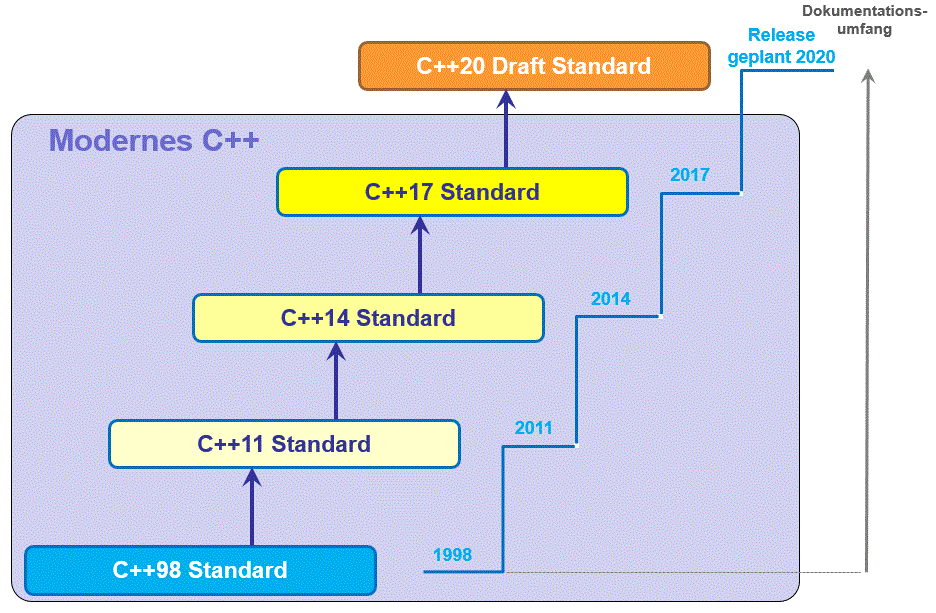
It is known, among other things, that the planned C++20 standard will expand the C++ language by two and a half to three times compared to the "well-known" C++98. Summarized across all standardization steps, these are some of the outstanding features in the area of language syntax:
- C++ Function Literals (Lambdas)
- C++ Rvalue References
- Range-based loops
- Multithreading
Further simplifications have been made in the area of C++ Meta-programming, which primarily allows the creation of universally reusable and compile-time optimized software components.
In the area of the standard library, in addition to many useful "little things", there were also new features. Container classes in addition, the „Chrono„-Library (points in time and time periods) as well as standard „Type traits“ to support meta-programming.
The „highlight“ of C++20 will probably be the C++ „Concepts“ be, a variant of C++, which is well known in object-oriented programming „Interfaces„"However, it does not take effect at runtime, but at compile time, thus allowing for a far greater degree of C++ code optimization. Furthermore, it opens up possibilities for (fully) automatic C++ optimization."„Type Deduction“prepared in the style of functional programming.”.
Bring your C++ skills up to date with the specially developed MicroConsult training course “Modern C++”.
Jetzt anmelden: Modernes C++: Die wichtigsten Sprachneuerungen von C++11 bis C++20