EN
EN  DE
DE There is hardly an experiment in psychology that reveals the dark side of human conscientiousness as clearly as the Milgram experiment. It shows that people are willing to harm others out of a sense of duty. What conclusions can be drawn from this for project work?
French researchers published the results of the most recent experiment on this phenomenon in 2010. Together with a director, they adapted the experiment into a reality game show. Eighty players were selected from a pool of 2,600 people to ensure representation of different age groups, professions, and genders.
The players were to ask questions of other supposed participants (insiders) and punish them with (simulated) electric shocks for incorrect answers. The tension was gradually increased. If the players had any doubts about the punishment, the host reminded them to please follow the rules.
The shocking result: Depending on the game's design, up to 70 percent of the participants were willing to go up to the maximum (lethal) voltage of 460 volts. This experiment thus confirmed Milgram's findings. Interestingly, these same groups of people were contacted eight months later to complete a personality test disguised as an opinion poll.
The survey was designed to determine the levels of the key personality traits extraversion, neuroticism, openness to experience, agreeableness, and conscientiousness, known as the "Big Five" – the five main dimensions of personality according to the personality inventory by Costa and McCrae. Subsequently, an analysis was conducted to determine whether there were any striking correlations between these traits and behavior in the experiment.
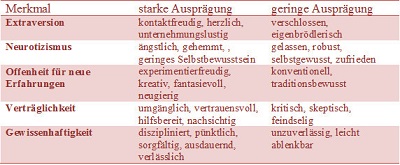
Table: „Big Five“ – the five main dimensions of personality according to the personality inventory by Costa and McCrae (Image: VBM archive)
According to this, high agreeableness and conscientiousness evidently favor a willingness to follow the rules of an authority figure, even if it demands such cruelty. It is particularly striking that these traits are usually advantageous and associated with a rather low propensity for aggression. People of this character use fewer drugs, are less likely to be involved in crime, and are more highly educated.
The cruel behavior in the game was therefore much more strongly influenced by a willingness to conform to the rules than by sadistic traits. Social pressure from majorities or authorities exerts a strong influence, especially on conscientious, harmony-seeking, and conservative individuals. This leads to the suppression of scruples, personal values, or compassion in favor of conforming behavior.
Conclusion for the project work: Just as it is important to define rules and insist on their adherence, it is equally crucial to critically examine these rules and review their validity in light of values such as humanity, compassion, and tolerance. The experiment also demonstrates the significant responsibility of leaders and opinion leaders. They have a duty to integrate health, social, moral, and ethical boundaries or to create effective bodies that advocate for these aspects.
Otherwise, the application of rules that, for example, make success the absolute priority, can lead to dangerous excesses, especially in the hands of the conscientious. On the other hand, the experiment shows how necessary it is to take doubts seriously and to question the reasons behind them. We are often too quick to label someone a "troublemaker." Even if it can sometimes be unpleasant to hear that cherished rules have their downsides, these people make a very valuable contribution. They help us maintain the balance between rule-following and humanity.
I look forward to your suggestions below. denkanstoss@microconsult.de.
Further information
Training & coaching
MicroConsult Training & Coaching on project management
MicroConsult training and coaching - overview
Food for thought:
Column by Peter Siwon about the human side of project work
Peter Siwon: Systemic project management