EN
EN  DE
DE 
Projects often stall because it's unclear what project responsibility means or how to effectively delegate it. This vague understanding of responsibility often leads to arguments and unnecessary back-and-forth. When it comes to responsibility, it's helpful to keep a few key concepts in mind. To illustrate these, I like to use a short thought experiment in my seminars. My fee: €50.
Imagine this: I put €50 on the table and ask, "Could someone please watch this money? I need to step out for a moment." And just like that, I'm out the door. Immediately afterward, a thug dashes into the room, snatches the money in a flash, and disappears with it.
What would happen? Think about the question for a moment before you continue reading.
Experience shows that those who witness the wrongdoing are initially perplexed and observe each other. Perhaps after a while, someone takes the initiative and tries to clarify what needs to be done and who will do it. A courageous participant might even pursue the perpetrator. However, as a rule, there is a delay or a complete blockage of any response. The reasons for this lie in the lack of commitment, the resulting diffusion of responsibility, and mutual obstruction. Let's examine this more closely.

What happens to project responsibility when tasks are delegated? This explains Peter Siwon with €50.
(Photo: foto art Elisabeth Wiesner)
Project responsibility and commitment
My non-committal transfer of responsibility to the group ("Could someone please...") meant that no one felt truly responsible. Firstly, it wasn't clear to whom I was addressing the request. The participants wondered: Did he mean me, my colleague, or all of us? Secondly, there was no active confirmation that anyone actually intended to fulfill the request.
A binding commitment arises when both sides are at least clear about, who did what when to do something, and the person or people actively confirm this – in the simplest case, with a nod or "Okay." Even more effective is an active repetition of the task by the person(s) taking it on. The clearer the confirmation and the more witnesses to this commitment are present, the stronger the perceived obligation to fulfill the responsibility or project accountability.
The sense of commitment is further enhanced when taking on a task is perceived as a personal decision. The perceived responsibility, or project responsibility, for tasks is greater when these are accepted freely or out of conviction. If a person is forced to assume responsibility, they tend to place that responsibility more on the assignor. Therefore, we should delegate tasks in a way that does not unnecessarily restrict the decision-making freedom of the person carrying them out. Granting them leeway in decision-making and shaping their actions increases their willingness to take responsibility.
Diffusion of responsibility and mutual obstruction
The perceived responsibility or project responsibility of each individual decreases the larger the group to which responsibility is generally assigned. Responsibility becomes diffusely distributed across the group. If 100 people are addressed, each person, while not mathematically speaking, metaphorically feels only one-hundredth of the responsibility. This naturally also reduces the willingness to take action.
Furthermore, individuals within a group observe each other to determine whether a reaction is appropriate. This resulting delay, in turn, unsettles them. Intuitively, questions like "Isn't it important that someone acts?", "Is it too dangerous to act?", or "Is it undesirable that someone acts?" run through their minds. This kind of delay has already cost many people their lives, because bystanders who might otherwise help block each other and thus waste valuable time.
Diffusion of responsibility and mutual obstruction can be avoided by clearly addressing individuals: "Ms. A, would you please take on this task?" After this request, we should ensure that the person actively confirms their willingness. If the entire team is to assume responsibility or project responsibility, each individual should confirm that they share the overall responsibility. No one can hide behind a tree with a sign nailed to it saying "It's someone else's fault." However, this also requires an all-for-one and one-for-all team spirit – and that doesn't just fall from the sky.
Responsibility can only be passed on as a copy.
The simplest solution to my €50 problem is to make a binding agreement with someone: "Mr. Müller, would you please hold the €50 for me until I ask you to return it?" Usually, the person takes the money with a sly grin. I ask Mr. Müller to confirm my request, which he gladly does. So now he's responsible for the money. But what about me?
Am I free of responsibility for the €50? Please think about this question briefly before continuing to read.
Imagine I planned to take my wife out to dinner with this money. Mr. Müller unfortunately lost the money and therefore couldn't return it. I arrive penniless for the date. My wife will rightfully hold me responsible for the loss, since it was my decision to entrust the money to Mr. Müller. The responsibility, therefore, always remains with the person who delegates the task. They can only transfer a copy of the responsibility for carrying out the task to the person performing it.
Even if Mr. Müller's money is stolen, neither his nor my responsibility is stolen. Even the thief receives a copy of the responsibility. Because if he is caught, he will be held accountable. Mr. Müller is responsible for the €50 because he allowed himself to be robbed. I am responsible for the money because I entrusted it to Mr. Müller. The thief is responsible because he broke a law. Mr. Müller would not be released from responsibility even if he had given the money to Ms. Schmidt for safekeeping and she had been robbed instead. The only way for him to be free of responsibility is to return the money (along with a copy of the responsibility) to me.
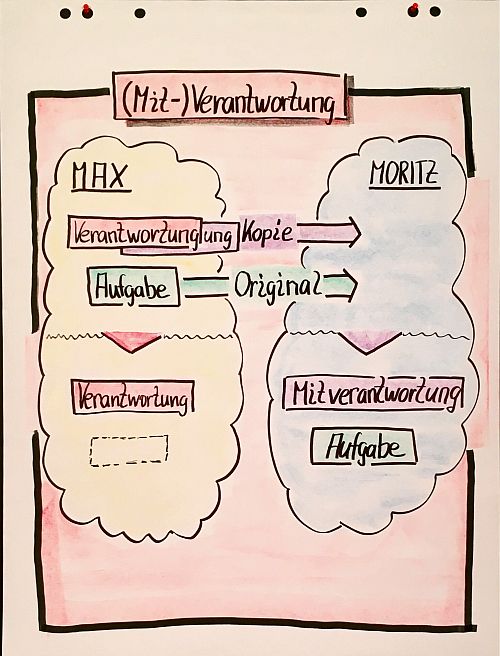
With each task, only a copy of the project responsibility is sent to the recipient.
(Image: Peter Siwon)
Shared responsibility, common responsibility
Of course, I could also distribute the responsibility for safekeeping the €50 among five people by, for example, giving each of them €10. This would mean each of these people would also assume responsibility for their €10. The overall responsibility remains with me.
Now, one last scenario: I hand over five €10 notes to a group, and we've clearly agreed that the group assumes responsibility for the €50. In this case, it doesn't matter how the group organizes the safekeeping in detail. They are responsible as a group, and therefore each individual member is responsible for the amount. You might already realize that there's a catch if the team can't embrace this shared responsibility. Then, in the event of loss, for example, they might try to find someone to blame and pass the buck to me. A responsible team would work together to find a solution. In the simplest case, I wouldn't even notice the loss.
Responsibility in the project
These considerations translate very well to the responsibilities of project management. Project management is generally responsible for the entire project and has the task and responsibility of effectively distributing project tasks and, consequently, project responsibilities. Effective distribution means that each task is clearly and bindingly assigned to a person, a group of people, or a legal entity (supplier) capable of fulfilling that task and the associated project responsibilities. If something goes wrong, the primary responsibility for finding a solution lies with the individuals who have taken on the task. They should be given a fair chance to live up to their responsibilities.
In any case, everyone involved in any way in delegating the task and the associated responsibility remains accountable for finding a solution. They will support the solution process to the extent necessary and possible. Should this prove unsuccessful, the question arises: Does the responsibility need to be redistributed to solve the problem, and if so, how?
As you can see, this isn't about finding someone to blame. It's about distributing responsibility in a way that allows for the desired results or the solutions to the problems at hand. Looking for someone to blame usually leads to the exact opposite of taking responsibility and finding solutions. Before you start looking for someone to blame, think about the €50 and your share of the responsibility.
verantwortung@systemisches-projektmanagement.info.
Further information
Training & coaching
MicroConsult Training & Coaching on project management
MicroConsult training and coaching - overview
Food for thought:
Column by Peter Siwon about the human side of project work
Peter Siwon: Systemic project management