EN
EN  DE
DE Everyone has a mental cube full of ideas. I could jokingly suggest that the tilting, frantic shaking, or frequent tapping of this body part, often observed when brooding, serves to set this cube in motion.
Unfortunately, the mental die is often very one-sided and tends to land on the same ideas and thought patterns repeatedly. Unlike a regular dice roll, this is permissible, but not necessarily desirable.
When we roll dice together with others to generate ideas, it sometimes happens that a worn die collides with another and lands on a completely unexpected side. "I would never have dreamed of that," we then hear. "The Lord gives to his beloved in their sleep," especially if one's mind has been thrown off course beforehand. And that works best with a shared idea-rolling session.
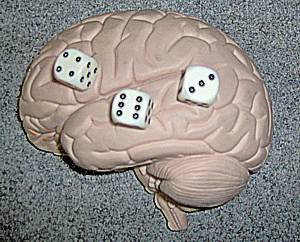
Everyone has their own "idea cube" in their head. Unfortunately, they tend to fall on the same solution patterns.
A quick statistics review: One die yields 6 different numbers, two dice yield 6 times 6, or 36 different numbers, three dice yield 6 times 6 times 6, which gives 216 different numbers, and so on. Of course, this simple algebra cannot be applied directly to our brains, but in principle, similar multiplication effects are at work.
Statistically speaking, the probability of new ideas increases simply by combining old ideas from different minds. This idea recycling is facilitated by humans' strong capacity for association and can yield surprising results.
There's another effect at play: the more pleasant the company, the more creative and diverse the ideas. Humans are naturally social players when it comes to brainstorming. And there are good reasons for this. Since we're born with largely unprogrammed brains, we depend from the very beginning on engaging in intensive exchanges with our parents and other trusted individuals. Because this exchange of ideas is vital, it's even rewarded with specific feel-good hormones. So, brainstorming together not only makes you smarter, but also happier.
Why, then, are so many software developers solitary idea generators and solitary thinkers, I wonder. When did they forget or abandon the art of brainstorming with others? Was it snatched away from them in the competition for grades, university places, and jobs? Were they too often punished with a pitying smile for a spontaneous but poorly thought-out idea? "Now, Mr. Smarty Pants, before you blurt out such half-baked nonsense again, conduct a marketing study, a business plan, and a profitability analysis." Did others constantly take credit for their work?
But is it a reason to forgo the fun just because others are spoilsports? Simply seek out teams and companies that provide spaces for brainstorming and encourage the use of idea dice. Or simply start inspiring others to do the same. Techniques for fostering creative teamwork, such as brainstorming, brainwriting, the reverse thinking method, the Metaplan method, or mind mapping, have long been known and proven. Experienced facilitators are happy to help introduce these or other methods. But it doesn't necessarily have to be a formalized method right away. Often, a shared coffee or lunch break can generate surprising insights. Flip charts or whiteboards where ideas can be spontaneously developed together are important catalysts that should be a feature of every office.
You don't need much to start rolling for ideas. It's usually just a lack of willingness to give it a try. But beware! Rolling for ideas can be addictive.
Tips: Methods for successful idea generation: Request now!
I look forward to your suggestions below. denkanstoss@microconsult.de.
Peter Siwon
Experiment: Source of ideas, change of perspective
The following experiment will show you how much you can gain by looking at the world together with other people or through the eyes of other people.
- Write down all the possible uses of a newspaper on a piece of paper.
- Form an idea cube group with children, partners or colleagues and collect all the ideas that come to mind together.
- Now, with this group, mentally experience a 24-hour day (workday, leisure time) and consider in which situations the newspaper could be used, also as a substitute for other things.
- Imagine yourself in the daily routine of other people (homeless people, artists, etc.).
- If you like, you can repeat the same game with clothespins, rubber bands, or whatever else you can think of.
Isn't it amazing how many different things such simple things can be used in?
Further information
Training & coaching
MicroConsult Training & Coaching on project management
MicroConsult training and coaching - overview
Food for thought:
Column by Peter Siwon about the human side of project work
Peter Siwon: Systemic project management