EN
EN  DE
DE 
Among the many programming languages popular with developers, one stands out as a chameleon, adapting to a wide range of requirements: Python. Python has long been known as one of the most widely used programming languages. But what makes coding with Python so special? Let's take a look at why it's worthwhile using Python in projects.
Python has already proven itself in a wide variety of application areas. Whether in data analysis, machine learning, web development, testing, scripting, or prototyping – Python is now used almost everywhere. From science and finance to education and software development, Python has proven to be an extremely flexible solution in key industries.
What is behind the popularity of Python?
But what makes Python so attractive to developers worldwide? Its compelling unique selling points are its simple syntax and excellent readability. Many even describe it as "quasi-pseudocode," meaning the code reads almost like a natural language and is therefore easy for many beginners to understand. Furthermore, Python is a high-level language that is platform-independent and can run on various operating systems and architectures. Another major advantage: Python is free and boasts a vast, constantly growing and evolving ecosystem.
The multi-paradigm language
A key feature of Python is its ability to support various programming paradigms. Whether object-oriented, functional, or procedural programming, Python offers a high degree of flexibility and easily supports different programming styles.
Object-oriented programming: Python supports all the key concepts of object-oriented programming, including abstraction, data encapsulation, inheritance, and polymorphism. This allows developers to design and implement complex systems in an efficient and well-structured way.
Functional programming:In addition to object-oriented programming, Python also offers support for functional programming concepts. These include immutability, higher-order functions, generators, lambda functions, and numerous built-in features such as... map, filter, enumerate, zip, all and any. These features constantly open up new possibilities for developers to design and implement their programs.
Another important aspect of Python is that it doesn't enforce a specific programming style. Users can choose the style or combination that best suits their needs and requirements. In contrast, some other languages, such as C#, enforce a particular style, for example, object-oriented programming.
The ecosystem brings a wealth of opportunities.
The Python ecosystem is vast, offering a wide range of libraries and frameworks that simplify and accelerate the daily work of developers. The standard library alone provides numerous modules for tasks such as file handling, date and time, text analysis, serialization and deserialization, and concurrency. Furthermore, there is a wealth of third-party modules available through the Python Package Index (PyPI). These modules cover almost every conceivable use case, including web services, numerical computation, data analysis, data visualization, machine learning, desktop development, and testing. Many of these modules are among the most widely used frameworks and libraries across languages, as indicated by the StackOverflow Developer Survey. hervorgeht.
Example of the diverse ecosystem: Use of pandas and plotly
An excellent example that highlights the versatility of the Python ecosystem is the use of pandas and plotly to analyze and visualize data. Let's say you have a CSV file containing hourly data and you want to summarize it into daily values for a better overview. This is where pandas comes in. With just a few lines of code, you can use pandas to read, aggregate, and format the data as needed. For example, you can calculate the sum of the hourly values for each day.
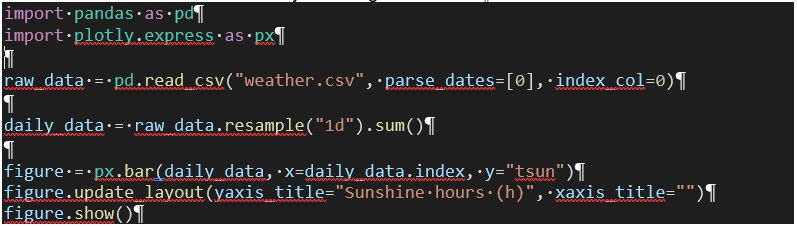
With plotly, you can then quickly and easily visualize the aggregated data, for example as a bar chart. This example illustrates how effortless it is to perform complex data analyses and create compelling visualizations, thanks to the powerful combination of pandas and plotly in the Python world.
With Python, there are no limits
Python continues to live up to its reputation as an extremely versatile and flexible programming language suitable for a wide range of applications. Its simple syntax, readability, support for various programming paradigms, and extensive ecosystem make it a popular choice for developers worldwide. Whether you want to analyze data, develop web applications, train machine learning models, or simply create prototypes, Python offers limitless possibilities.
The MicroConsult Python Trainingprovides you with a solid foundation for programming with Python. This includes, in particular, working with complex data types and object-oriented programming with Python. Furthermore, the most important Python libraries from the standard library (e.g., os, sys, pickle, json, datetime, tkinter, sqlite3) and from third-party providers (e.g., pytest, requests, numpy, pandas, Flask, plotly) are introduced in theory and practice. Through numerous practical exercises, you will develop a feel for the language and learn how to effectively develop and test programs.
Further information
MicroConsult Training: Python – Object-Oriented Scripting Language