EN
EN  DE
DE The term Embedded program development – embedded programming (embedded programming) refers to a special type of programming for embedded systems.
What is an embedded system?
Embedded systems are functional units into which their own processing core is integrated (implemented). The processing core (e.g. Microcontrollers) is "embedded“ in the system and not recognizable as such from the outside.
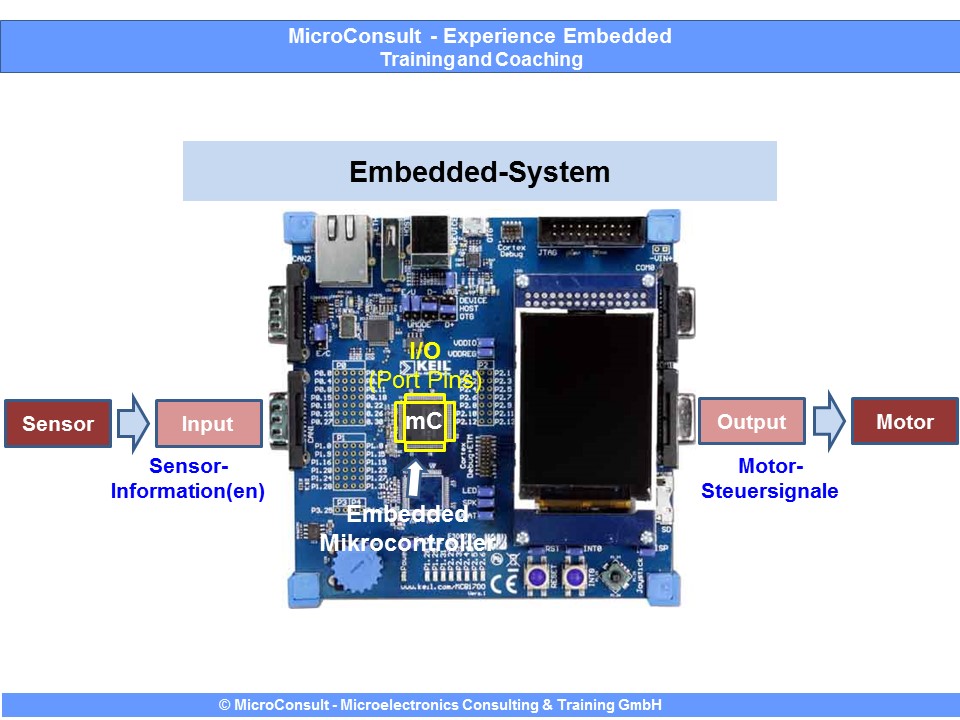
Figure 1: Embedded system
The processing core executes a program that is programmed into the microcontroller's memory (flash memory). Compared to CPUs, microcontrollers have the advantage that almost all the functionalities of a PC are contained in a single component (program and data memory, CPU, timer, serial interfaces, etc.). The program contains the "recipe" according to which the microcontroller should operate.
It is programmed into flash memory and contains, for example, commands to be executed. This allows input information from sensors, switches, potentiometers, etc., to be read via the microcontroller's I/O (port pins). The input information is then checked and processed. Further commands calculate control output information and output it via output port pins.
The formula (the program) must be created in such a way that all timing requirements are monitored and adhered to. This is referred to as the real-time behavior of the program. The program must be written using only instructions that the specific microcontroller can execute.
Likewise, all addresses of the memory and peripheral modules must be applied correctly so that the overall timing specifications are correctly adhered to.
Special embedded development tools are available for this purpose. These embedded development tools include embedded cross-compilers, linkers/locators, and embedded debugging and testing tools.
Procedure for embedded programming of a microcontroller program
- It begins with the recording of requirements.
- The defined requirements are structured; based on this, the embedded architecture of the software is developed.
- The correct microcontroller architecture is then selected for the required processing.
- The program is created (coded) using an embedded programming language (e.g., Embedded-C or Embedded-C++) and compiled with an embedded compiler.
- Unit tests for the individual program modules (units) follow, for example, using an embedded debugger. Several program modules can then be integrated into a subsystem. This is where the integration test is performed. All subsystems can then be combined to form the complete system. The test for this is called a system test.
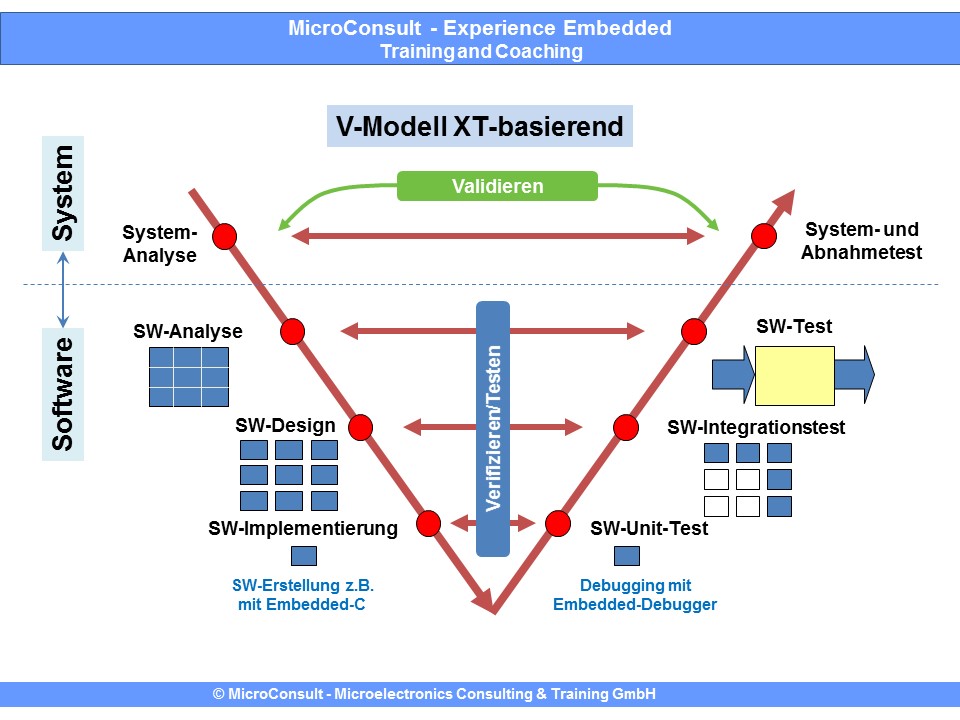
Figure 2: Embedded program development in the V-model
Tools for embedded program development
Programming for embedded systems is therefore based on embedded tools. These tools are specifically developed for the selected microcontroller architecture by tool manufacturers and used by embedded developers for programming., Debug and used for testing.
For a successful entry into the world of embedded programming, special knowledge is required – from microcontroller architectures, requirements engineering and management, and architecture design for embedded systems to embedded programming languages with embedded compilers, linker/locator (Embedded-C and Embedded-C++) as well as embedded debugging and testing tools.
Expertise in embedded program development
Training courses offer the right access to all this knowledge and skills: Requirements engineering and management, design for embedded architectures, Embedded Programming, embedded debugging and embedded testing.
MicroConsult supports you with training and coaching on all aspects of embedded program development, e.g., on the following topics:
- Embedded C: Programming Methods and Tools for Embedded Applications (training)
- Embedded C++: Object-Oriented Programming for Microcontrollers with C++/EC++ and UML (training)
- Embedded C++ Advanced: Object-Oriented Programming for Microcontrollers with C++/EC++ (training)
- Embedded Software Design and Patterns with C (training)
- Saubere, effiziente und robuste C++-SW entwickeln mit klassischer Objektorientierung und modernen C++ Sprachmitteln – Der Weg zum Clean Code
- Software Architectures for Embedded Systems and Real-Time Systems
- RTOS Fundamentals and Application: Mechanisms and their Use in Runtime Architectures for Embedded and Real-Time Systems
- Requirements Engineering and Requirements Management for Embedded Systems
- Embedded and real-time programming – all training courses
- Embedded and real-time operating systems – all training
- Coaching: Embedded and real-time programming
For training & coaching on other topics in our portfolio, please click here.
Embedded program development workshops
Furthermore, we offer individual workshops that highlight embedded software development - tailored to the specific needs of tasks, projects, teams, and roles.
Please contact us with your questions, requests and requirements – we are happy to assist you at +49 (0)89 450617-71. Or send us the contact form.