EN
EN  DE
DE 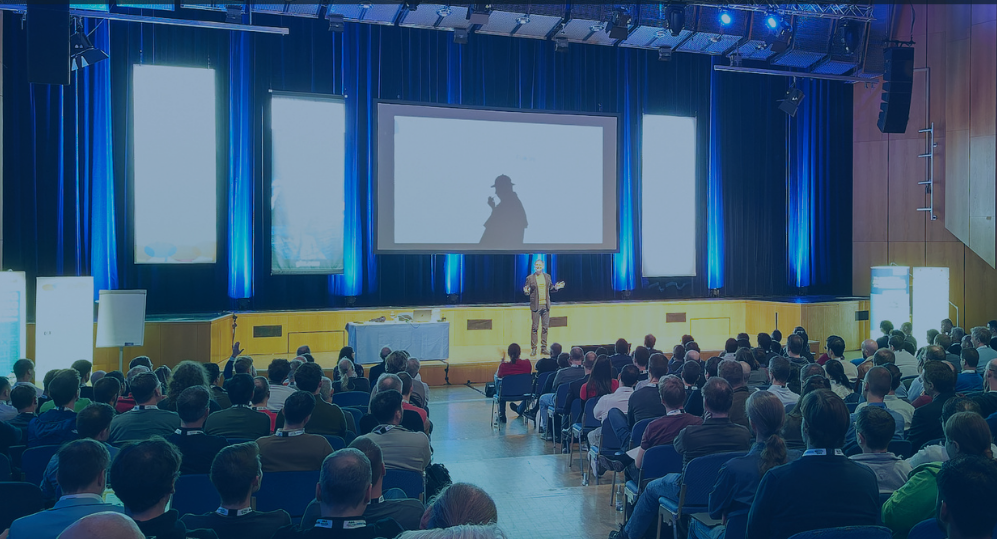
From 30 November to 4 December, the embedded software community will once again get together in Sindelfingen. Every year, developers, managers, and project leaders gather here to delve deeply into the latest embedded topics and think outside the box.
Join this get-together of the embedded software community and benefit from discussions and expert panel sessions for an efficient exchange of knowledge and successful networking. In addition to over 100 technical presentations, keynotes, and compact seminars, you can also expect an extensive exibition with the industry’s leading companies. Learn all about the latest trends, challenges, and solutions in embedded software engineering—from AI, safety, and security to management and innovation.
To get you in the mood for the face-to-face conference, there will be an online preconference on FRI 27 November, amongst others, with the presentation "C++ Templates – A Basic Introduction” by MicroConsult trainer Thomas Batt.
Thomas will explain the basic concepts of template-based programming in C++. Templates enable software developers to save development time and costs. From an architectural and design perspective, they increase the flexibility, adaptability, extensibility, and reusability of software - all while being fully generated at compile time and without runtime overhead. Using simple examples, the session will cover key topics: the basic concept of generic programming, template functions and classes, implicit versus explicit instantiation, template classes with size parameters, their use in polymorphic structures, as well as advantages and disadvantages, recommendations, and a brief overview of advanced topics. Participants will gain an understanding of the programming and application approach of templates and will be able to create their own templates as well as understand and maintain existing ones.
The agenda of the online preconference will be published around mid-October; participation is free for everyone.
MicroConsult will be represented in Sindelfingen not only as an organizer but also as an exhibitor and with own presentations and seminars.
Our presentations and seminars at ESE 2026
Interrupt service routines implemented as pure C functions offer only limited flexibility and variability. The presentation "Executing C++ (class) functions in the interrupt context"first demonstrates how a static class function can be linked to the interrupt vector using C++, independent of the development environment—a simple solution, but one that is limiting when applied to a consistently object-oriented design. In the second part, a more advanced variant using modern C++ is presented, which enables access to object data even in the interrupt context. Thanks to its high level of abstraction, the interrupt service is platform-independent and universally applicable to all interrupts; type-safe passing of a wide variety of argument types rounds out the solution. The presentation, featuring real-world code examples, empowers participants to decide how to use C++ in the interrupt context for their embedded software and how to optimize existing approaches—always taking specific software requirements into account. Thomas Batt will explore this topic in his presentation on TUE 01 December at 17:35 h.
On FRI 04 December at 09:30 h, he will give his compact seminar "Modeling embedded software with UML",to explain the notations of standardized UML diagrams (including use-case, package, class, sequence, activity, and state transition diagrams) using technical examples and applies them step-by-step in an embedded software UML model. He demonstrates the practical, consistent use of the diagrams across the process steps of software requirements analysis, architecture, and design, and additionally covers UML tools (function and selection), template models, profiles, style guides, and code generation—using Sparx’s Enterprise Architect as an example and applicable to other tools. Participants, such as requirements analysts, architects, designers, and developers, learn to scale UML notation for their projects and processes, apply it professionally and in a use-case-oriented manner, and understand, extend, and optimize existing models.
Although security for embedded systems is not a new topic, the Cyber Resilience Act (CRA) has brought renewed attention to the issue. MicroConsult trainer Marcus Gößler will hold the seminar "Understanding and applying security and CRA"to explore the fundamentals of security engineering and a holistic approach, ranging from organizational measures and processes to TARA, cryptographic methods, testing, and market monitoring, all the way to attacks and threats. The focus is on a practical methodology that can be broadly applied to products and processes while simultaneously meeting the requirements of the CRA, ensuring that security measures are not implemented in an uncoordinated manner or with unclear benefits. The seminar takes place on MON 30 November at 09:30 h and addresses anyone who needs to understand and implement the CRA and security measures.
Register by 30 October and benefit from our Early Bird rates!
 MicroConsult continuously offers services related to the topics discussed at the event: Trainings, courses, seminars and coachings.