EN
EN  DE
DE 
Capturing and managing requirements is a key to successful projects. Whether in a traditional or agile process environment, professional requirements engineering and management for embedded and real-time systems shortens your project timelines and saves on development and maintenance costs. Take on this challenge!
After defining the requirements using a Checklist in Part 1 and the Design of the processes in Part 2 Read below to learn how to manage, track, and link requirements in requirements engineering and management, and how to select and establish the necessary tools.
Reuse requirements
Especially in companies that consistently develop the same or similar products, reusing requirements is advantageous. One approach is the minimal platform concept: separating the requirements common to all products as platform requirements and referencing them in the individual product requirement set. An alternative is the maximal platform concept. The maximal platform contains all requirements for a product group. For new products within this group, you reference the corresponding valid and versioned requirements.
Parameterize requirements
Even in the context of requirement reuse, you can populate the requirement text with variables and units whose values you can adjust individually for each product in the parameter lists, e.g. the maximum power consumption Pmax in watts.
Define requirement properties (attributes).
Equip your requirements with properties that are actually useful to you. Sometimes less is more. Besides a unique ID (e.g., REQ-EMB-SW_000001) for identification and referencing, each requirement should also have a status (e.g., in progress / released / implemented / tested). Maintain all properties; otherwise, they will be useless in the process.
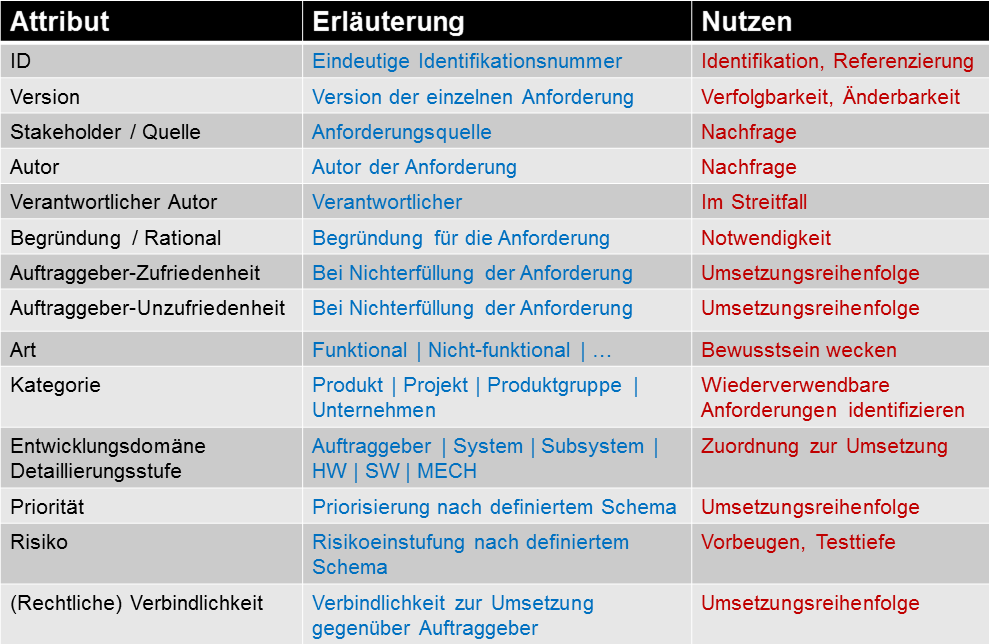
Figure 4a: Examples of possible requirement properties
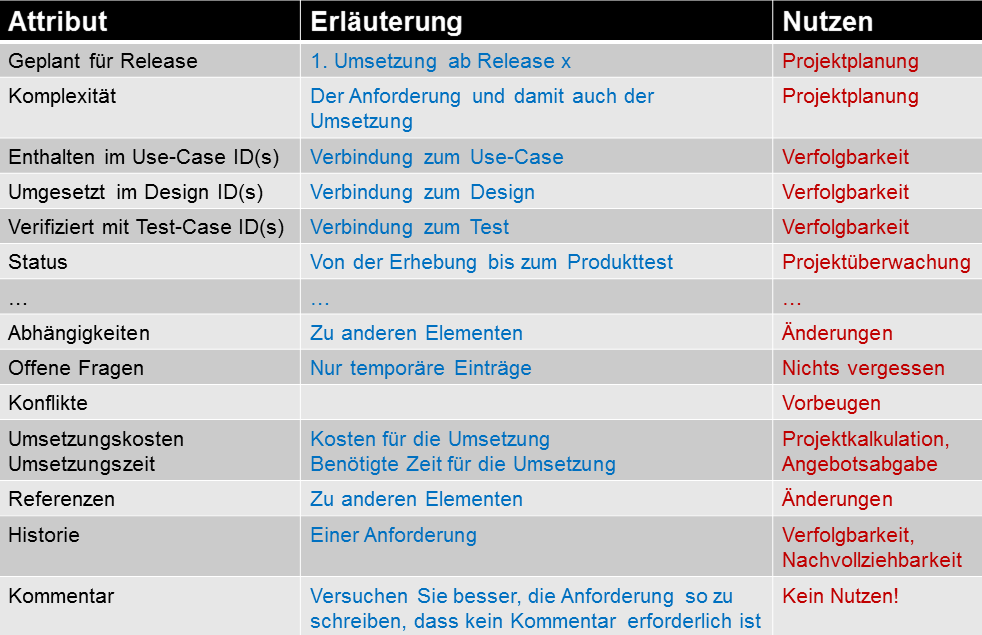
Figure 4b: Examples of possible requirement properties
Establish a versioning of requirements
The version as a property of the requirement allows you to track its development and evolve requirements further in the future.
Establish baselining/releases for requirements
At a defined point in the project timeline, you document the current maturity of the requirements for further implementation.
Establish bidirectional traceability across all development stages
Standards for safety-critical systems typically require bidirectional traceability (linking) between requirements, implementation, and test cases. Achieving this across different development domains and their various tools is the key challenge ⇒ tool integration, standards such as ReqIF and STEP to help with that.
Provide templates for artifacts
Provide templates for the artifacts in your process. This ensures that the same artifact types (e.g., requirements specifications) always look the same, thus improving understanding. The predefined content prevents you from overlooking any points that need addressing. Standards already exist for many artifact types.
Requirements Management Tools
Text verse. Evaluate Application/Product Lifecycle (A/PLM) tools
Basically, when choosing tools, you have to decide between purely text-based or database-oriented tools. The complexity of your products will continue to increase. The more requirements and other artifacts you have to manage, the better database-oriented tools will support you.
Select tool based on requirements
There is no single "best" tool on the market. At best, there is the tool that best meets your needs and requirements. When selecting a tool, remember the following order: first the person, then the method, and then the tool! Tool selection should not be a company policy decision.
Integrate, test, and train on the tool
Integrate and test the selected tool before the project begins. To counteract potential user resistance, they should receive training before using the tool.
Establish this tool in daily work
Establish the tool across multiple departments. A continuous learning and improvement process should be implemented here as well.
Summary
For each individual checklist item*, you must weigh the associated benefits against the implementation effort. The best items for you are those with high benefits and low implementation effort.
*The Requirements Engineering and Management Checklist is available for you as a PDF Available for download here.
Everything about Requirements Engineering and Management
Get in MicroConsult Seminar on Requirements Engineering and Management The necessary knowledge to develop and document high-quality requirements and corresponding acceptance criteria. The recently revised version of the seminar is based on over 10 years of practical coaching and seminar experience.
Learn more in seminar, how to assess and improve the quality of existing requirements, how to introduce, evaluate, optimize, understand and implement a requirements process in your company, and how to make informed tool decisions for managing requirements.
Part 1 This series highlights the Defining the requirements; in Part 2 Learn all about Process, procedure, method in requirements engineering and management.
Further information
MicroConsult expertise in process management
MicroConsult Training & Coaching on the topic of process management
Seminar: Requirements Engineering and Requirements Management
Read more:
Part 1: Requirements – A checklist for maturity?
Part 2: Process, procedure, method in requirements engineering and management
Featured image: Adobe Stock