EN
EN  DE
DE 
Modern embedded systems have undergone fundamental changes in recent years. What began as simple, loop-based programs written in C has evolved into highly complex system software with strict real-time requirements, diverse peripherals, and parallel tasks. Whether in automotive control units, industrial control systems, medical technology, or IoT gateways, embedded systems must function reliably, deterministically, and maintainably everywhere.
This is exactly where a real-time operating system (RTOS) comes into play. It forms the foundation for structured, scalable, and real-time-capable system software and is no longer just “nice to have,” but a central building block of modern embedded architectures.
Typical challenges of modern embedded applications
Before we look at what an RTOS does, it’s worth taking a look at the typical problems of traditional embedded applications without an operating system:
Real-time constraints:
Control and communication functions must meet defined deadlines; delayed execution must not cause a system failure.
Scalability:
Superloop architectures quickly reach their limits. Every new function increases complexity and reduces clarity.
Shared resources:
Peripherals, memory, and bus systems are used by multiple functions. Without clear access strategies, race conditions and system instability are a risk.
Concurrency management:
Control loops, communication services, user interfaces, and diagnostic functions must run virtually in parallel.
Maintainability and reusability:
Monolithic code is difficult to debug, extend, and reuse in other projects.
An RTOS systematically addresses precisely these issues and offers proven mechanisms to make complexity manageable.
RTOS as centralized system software layer
Architecturally, an RTOS sits between the hardware abstraction layer (HAL) and the application. It serves as a framework for the entire system software and provides fundamental services:
- Task scheduling
- Inter-task communication
- Timing control and monitoring
- I/O- und Kommunikationsdienste
This clearly defined separation of layers results in a modular architecture in which application software can be built in a deterministic and traceable manner.
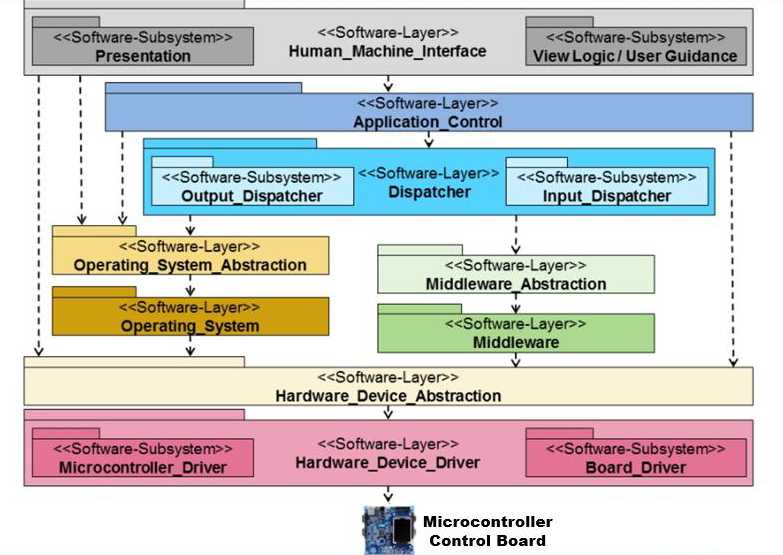
Figure 1: Separation of layers
From superloop logic to task-based architecture
One central concept of an RTOS is task-based decomposition. Instead of a single infinite loop (while(1)), the application is broken down into logically separate tasks. Typical examples:
- Task_A: Sensor acquisition
- Task_B: Control algorithms
- Task_C: Communication stacks (CAN, SPI, UART, Ethernet)
- Task_D: User interface (UI)
- Task_E: Task diagnostics and logging
Each task has a clearly defined purpose, its own priority, a separate stack, and a specified timing behavior. This modularity reduces coupling, improves timing predictability, and significantly simplifies debugging and extensions.
Deterministic scheduling and true real-time behavior
The true strength of an RTOS lies in deterministic scheduling. Most RTOS kernels use priority-based interrupt-driven scheduling for this purpose:
- Tasks with higher priority interrupt tasks with lower priority. Important to note: In an RTOS, task priority refers to the software priority of the RTOS scheduling software, not to the hardware priority of an interrupt controller.
- Critical tasks always meet their deadlines.
- The worst-case execution time (WCET) can be analyzed.
Among other things, an RTOS guarantees:
- Limited interrupt latencies – response time of nested interrupts
- Defined context switch times – time required to save the system resources (e.g. CPU registers) used by a single task
- Predictable task execution order – guarantees the task sequence/task queue during task execution
This allows for the analysis of worst-case execution times (WCET) and the reliable fulfillment of hard real-time requirements – a must for safety-critical systems such as motor controls, machinery, or medical devices.
Secure inter-task communication and synchronization
In real-world systems, tasks must communicate with one another and coordinate shared resources. An RTOS provides standardized mechanisms for this:
Communication:Queues, mailboxes, and event flags enable secure data exchange between producer and consumer tasks.
Synchronization:Semaphores, mutexes with priority inheritance, and critical sections ensure controlled access to resources and prevent priority inversion or race conditions.
These services replace error-prone flag polling and contribute significantly to system stability.
Precise time management instead of busy waiting
Timing is essential in embedded systems. RTOS provide key timing services for this purpose, typically based on a system tick (e.g. 1 ms):
- Delays with defined resolution
- Periodic task execution
- Timeouts for communication services
- Watchdog servicing
Major advantage: Tasks do not actively wait (busy-wait), but instead release the CPU. This not only increases determinism but also the system’s energy efficiency.
Clear separation of interrupts and application logic
A proven RTOS design principle is the separation of ISRs and task context. Interrupt service routines handle only the minimum necessary, time-critical tasks. The actual processing takes place later in tasks, triggered via queues or semaphores. This results in
- lower interrupt latency
- better system responsiveness
- simplified debugging and more efficient timing analysis
This structure is a crucial quality factor, especially in complex systems.
Memory strategies for stable systems
RTOS-based systems often rely on static or strictly controlled dynamic memory management. Typical concepts include:
- private task stacks
- fixed-size memory pools
- targeted use of heaps with fragmentation control
This helps prevent unpredictable runtime errors, which frequently occur with uncontrolled dynamic memory usage.
Maintainability, portability, and certifiability
In the long term, RTOS-based architectures offer multiple benefits:
- Maintainability: clear separation of tasks and services
- Portability: application logic remains usable across different MCUs
- Certifiability: Many RTOSs comply with standards such as IEC 61508, ISO 26262, or DO-178C
This is a decisive advantage, particularly in the automotive, industrial, and aerospace sectors.
Conclusion: RTOS as the foundation of modern embedded systems
Today, a real-time operating system is far more than just an optional software component. It is the foundation for reliable, scalable, and maintainable embedded system software.
Durch Tasks, deterministisches Scheduling, saubere Communication:, präzises Timing und kontrolliertes Ressourcen-Management verwandelt ein RTOS monolithische und fehleranfällige Strukturen in robuste Systemarchitekturen. Für Entwickler:innen bedeutet das: mehr Kontrolle, bessere Qualität und die Sicherheit, auch anspruchsvolle Echtzeitanforderungen zuverlässig zu erfüllen.
Real-time operating systems are among the key disciplines that embedded developers should master. Benefit from the expertise offered in our training courses to learn more about them.
Further information
Training: RTOS Application: Development of Runtime Architectures for Embedded and Real-Time Systems
MicroConsult Training & Coaching: Embedded and real-time programming
MicroConsult Training & Coaching: Embedded and real-time operating systems
MicroConsult Expertise: Embedded and real-time software engineering